Voice Search and Local SEO: What “Near Me” Queries Actually Need
Voice Search and Local SEO: What “Near Me” Queries Actually Need Voice search local SEO is about making your business...
Read More → If you’re comparing on page seo services with off-page seo services, the difference comes down to control: on-page SEO is everything you optimize directly on your own website — content, meta tags, site structure, and technical factors — while off-page SEO is everything that happens outside your website to build authority, mainly backlinks and brand signals. Both work together, but they solve different problems, and most sites that struggle to rank are actually weak in one of the two, not both.
On-page SEO is the part of ranking you have full control over. It’s every element sitting on your own pages that you can edit today without asking anyone else’s permission.
This includes:
The mistake most businesses make here is treating on-page SEO as a one-time checklist. It’s not. Google’s algorithm keeps evolving around what “useful content” means, and a page optimized two years ago with thin content and generic headings will keep losing ground even if nothing was technically wrong with it.
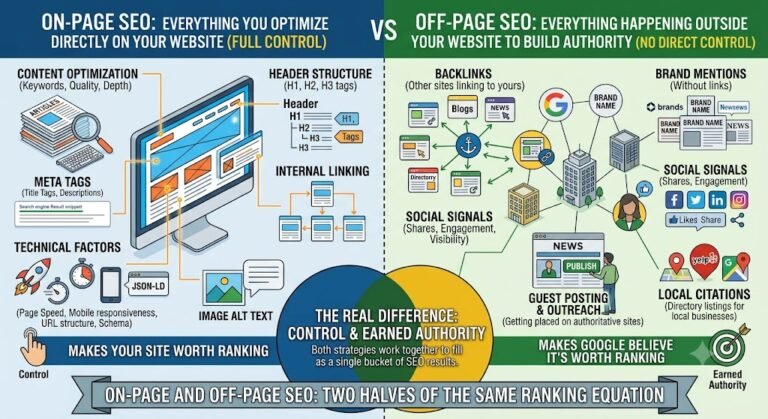
Off-page SEO is everything that happens away from your website that still affects how your website ranks. You don’t directly control it — you earn it or build it.
The core pieces are:
Off-page work is slower and less predictable than on-page work because you’re relying on other websites to cooperate. But it’s also the part that separates a page that’s technically perfect from a page that actually outranks competitors — because Google still weighs external trust heavily, especially in competitive niches.
Here’s where a lot of confusion comes in. People treat on page and off page seo as competing strategies, when really they’re sequential. On-page SEO makes your site worth ranking. Off-page SEO makes Google (and other sites) believe it’s worth ranking.
Think of it this way: if your on-page SEO is weak — thin content, missing meta tags, slow load times — then backlinks from off-page work are being pointed at a page that can’t convert that authority into rankings. You’re pouring water into a bucket with a hole in it.
On the flip side, a page with flawless on-page SEO but zero external authority will often plateau. It might rank for low-competition, long-tail terms, but it won’t break into competitive search results without some off-page backing.
A realistic priority order for most businesses:
If your site is new or was recently redesigned, start with on-page SEO. There’s no point building external authority toward a page that isn’t structured to rank or convert once traffic arrives. If your on-page SEO is already solid and rankings have stalled, that’s usually the sign to shift budget toward off-page work.
If you want a full breakdown of what’s included in the on-page process, our On-Page SEO Services page covers content optimization, meta tags, and technical factors in more detail. If backlinks and authority-building are the piece you’re missing, our Off-Page SEO Services page covers how that process actually works.
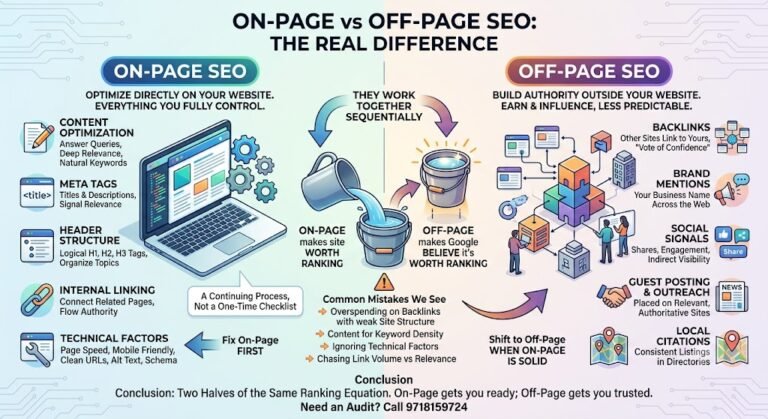
On-page SEO covers everything you control directly on your website — content, meta tags, headers, and technical factors. Off-page SEO covers everything outside your website that builds authority, mainly backlinks and brand signals.
Neither works well alone. On-page SEO needs to be solid before off-page work can convert into real rankings, but very competitive keywords usually require both working together.
For low-competition, long-tail keywords, strong on-page SEO alone can rank. For competitive terms, most sites need some level of off-page authority as well.
Backlinks are off-page SEO because they come from other websites, not from anything you edit directly on your own site.
Content optimization is on-page SEO — it’s about how well your page itself answers the search query.
On-page changes can show movement within a few weeks once a page is re-crawled and re-indexed, though full impact often takes a couple of months depending on competition.
Off-page SEO is generally slower — backlinks and brand authority typically take a few months to meaningfully affect rankings, since trust builds gradually.
Meta titles influence rankings directly by signaling relevance, while meta descriptions mainly affect click-through rate rather than ranking position itself — but both matter for overall performance.
Technical factors include page speed, mobile-friendliness, crawlability, secure HTTPS setup, clean URL structure, and schema markup — the backend elements that let search engines read your site properly.
Small businesses with limited budgets should fix on-page fundamentals first, since it’s the lower-cost, higher-control piece, then move budget toward off-page work like backlinks and local citations as the site grows.
On-page and off-page SEO aren’t rival strategies — they’re two halves of the same ranking equation. On-page SEO gets your website into a shape where it deserves to rank: solid content, clean meta tags, and technical factors that don’t get in the way. Off-page SEO tells the rest of the internet — and Google — that your site is worth trusting. Skip either one and you’ll hit a ceiling you can’t explain. If you want a proper audit of where your site currently stands on both fronts and a clear action plan to fix the gaps, call us at 9718159724 and we’ll walk you through it.