Voice Search and Local SEO: What “Near Me” Queries Actually Need
Voice Search and Local SEO: What “Near Me” Queries Actually Need Voice search local SEO is about making your business...
Read More → The digital pr vs link building debate has a fairly clear answer in 2026. Digital PR earns stronger, longer-lasting links when your brand has something newsworthy to say. Traditional link building still delivers steady, lower-cost wins through resource pages, guest contributions and broken-link fixes. Most sites get the best results by running both, with digital PR building authority and link building adding volume. Here is how each approach works, where each one fails, and how to decide where your time and budget should go.
Digital PR is the practice of earning coverage on news sites, industry publications and respected blogs by giving journalists something worth reporting. The backlink is a by-product of that coverage, not the thing you ask for.
A typical campaign starts with an original angle. That could be a data study, an expert opinion on a trending topic, a survey, a useful free tool or a strong reaction to an industry event. You then pitch it to reporters who cover that beat. If they publish, you get earned media links from pages that already carry trust and readership.
The links come from editorial decisions. That is why search engines treat them as strong signals, and why they are hard to fake.
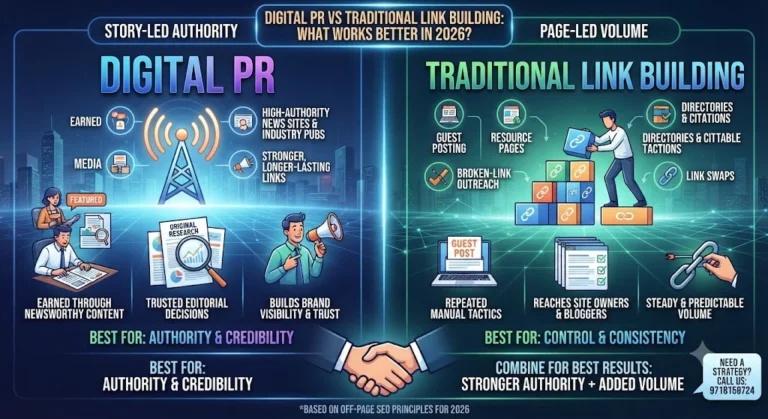
Traditional link building is a broader, more manual set of tactics. It usually includes:
The work is repeatable and easy to scale. The trade-off is that you are often asking a site owner for a favour, so the quality of the link depends heavily on the site and the pitch.
The biggest difference is what you are selling. In link building, you are selling a page. In digital PR, you are selling a story.
That changes who you talk to and what you get back. Digital PR is aimed at journalists and editors, and the links usually come from news and major industry publications. Link building is aimed at site owners and bloggers, and the links usually come from niche blogs, resource pages and directories.
It also changes the pace. Digital PR is slower and results can be spiky, since one strong campaign may bring a burst of coverage and the next may bring none. Link building is steadier and easier to predict, which makes it simpler to scale with a fixed process.
Brand impact differs too. Digital PR adds visibility and mentions on top of SEO value, while link building mostly delivers SEO value. On cost, digital PR needs more money upfront for research and creative work, whereas link building costs less per link but takes more manual hours. Each has its own risk as well: a PR campaign may simply not get picked up, and low-quality or paid-looking links from link building can backfire.
Three shifts explain why more SEO teams are moving budget toward digital PR for SEO.
Search engines reward real-world signals. Coverage in a recognised publication shows that people outside your own site consider you a credible source. That is much harder to imitate than a guest post placed for a fee.
Brand mentions now matter alongside links. Even when a publication does not link to you, being named as a source builds the kind of recognition that supports rankings and referral traffic over time.
AI answers lean on trusted sources. Generative search tools tend to pull from pages and publishers they see as authoritative. Earned coverage puts your brand in those places. We cover this angle in detail in our post on Link Building for AI Citations, which is worth reading alongside this one.
None of this makes traditional tactics obsolete. It means low-effort, low-quality link placement carries less weight than it used to.
Link building earns its place in a few situations.
If you run a smaller site without a natural news angle, a well-run outreach process can still produce relevant links reliably. Local and niche businesses often benefit most, since a link from a relevant regional directory or supplier page can matter more than a national mention they will never get.
It also fills gaps. Digital PR tends to point links at a campaign page or a study. Link building lets you support specific service or product pages that journalists would never cover.
Finally, it is easier to control. You can set monthly targets, track outreach and adjust quickly, which is difficult with story-led campaigns.
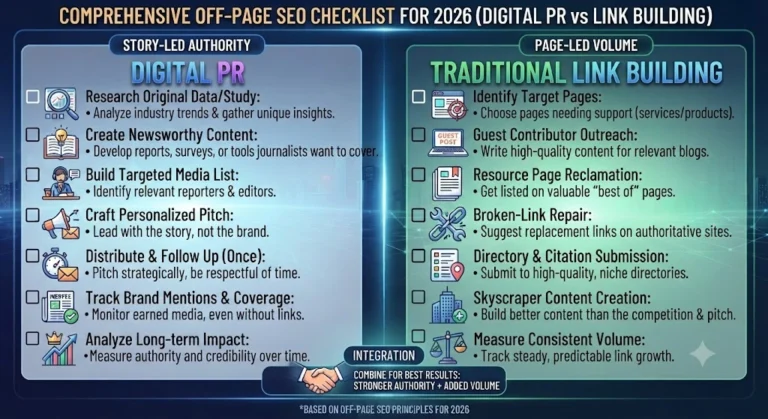
Journalist outreach is where most digital PR campaigns succeed or fail. A few habits separate the ones that get replies from the ones that get ignored.
Newsworthy content answers one question: why would someone outside your company care about this today?
Angles that tend to work include original data no one else has published, a fresh take on a debate the industry is already having, a practical tool or calculator people can use, and expert commentary tied to a current event. Timing matters as well. A good story pitched a week too late is just old news.
What rarely works is repackaging a product announcement as news. If the only person who benefits from the story is you, journalists will see that straight away and move on. The strongest earned coverage comes from campaigns where the audience gets something useful first.
A simple way to decide:
This choice also sits inside a bigger picture. Both methods are parts of a complete off-page SEO strategy, which we break down in our Off-Page SEO pillar guide.
Digital PR earns links by pitching newsworthy stories to journalists, while link building usually involves asking site owners to add or place a link. One is story-led, the other is page-led.
It is often stronger for authority and brand trust, but not automatically better for every site. Link building still works well for niche, local and page-specific goals.
It varies. Coverage can appear within days of a pitch, but the full SEO impact usually builds over weeks or months as links and mentions accumulate.
Earned links from editorial coverage are generally viewed as more credible because someone independent chose to reference you. Good guest posts on relevant sites can still be useful, though
Not necessarily. Large data campaigns cost more, but smaller efforts like expert commentary, responding to journalist requests and useful original insights can be done with limited spend.
Original research, surveys, useful tools, expert opinions on current topics and well-timed reactions to industry news are the most common formats to attract earned coverage.
They can. Even when a link is nofollow, the mention can bring referral traffic, build brand recognition and support the wider signals around your site.
Yes. Local newspapers, trade publications and niche blogs are often more receptive to small businesses than national outlets, especially when you offer a genuine local or expert angle.
Link earning means creating something valuable enough that others reference it on their own or through PR. Link building means actively going out to request or place links.
Usually no. A mix tends to perform better, since digital PR drives high-authority coverage while link building supports specific pages and keeps a steady flow of relevant links
Digital PR and traditional link building are not rivals so much as tools for different jobs. Digital PR wins on authority, credibility and brand visibility, but it depends on having a story worth telling. Link building wins on control, consistency and the ability to support specific pages. In 2026, the smartest approach is to let newsworthy content and journalist outreach build your reputation while steady, relevant link building fills in the gaps.
If you want help planning a link strategy that fits your website and budget, call us on 9718159724.