Voice Search and Local SEO: What “Near Me” Queries Actually Need
Voice Search and Local SEO: What “Near Me” Queries Actually Need Voice search local SEO is about making your business...
Read More → Unlinked brand mentions SEO is the idea that when a website talks about your brand by name without linking to you, that mention can still support your search visibility. Google doesn’t need a clickable link to notice that people keep talking about a business. It reads the text around the name, connects it to a known entity, and treats steady mentions as a sign of what that brand is known for. Links are still the strongest signal. Mentions fill in the gaps that links can’t.
An unlinked brand mention is any place online where your brand, product or founder is named but no hyperlink points to your site. A journalist writes “according to Brightline Analytics” (a made-up brand, for illustration) and doesn’t link. A podcast host recommends you in the show notes without a URL. A forum user says your tool fixed their problem.
Most brands collect far more of these than they realise, and most never act on them.

Search engines have moved from counting links to understanding things: brands, people, places and topics. A mention helps in that process even without a link. Here is what it can give you:
To be clear, Google has not published a rule saying mentions are a direct ranking factor. Treat them as supporting evidence that works alongside links, content quality and technical SEO.
When your brand is mentioned, Google’s systems try to work out which entity the name refers to. A brand called “Mercury” could be a planet, a car or a software company. Context settles it: the surrounding sentences, the page topic and the other names that appear nearby.
Consistency helps a lot here. If sites use your name in different forms (“ABC Digital”, “ABC Digital Agency”, “abc-digital”), the signal gets diluted. Use one standard name across your website, social profiles, directory listings and press mentions. The practical value of unlinked brand mentions SEO is largely this: more clear, consistent mentions make it easier for Google to be sure who you are.
Co-citation happens when your brand is mentioned alongside other known names in the same topic, even if none of them are linked. If articles about email marketing regularly list your tool next to established ones, Google can associate you with that space.
Implied links follow similar logic. A Google patent has described the concept of an implied link, where a mention could be treated as something like a link signal. A patent doesn’t prove Google uses it that way today, so don’t build a strategy on that claim alone. The safer way to look at unlinked brand mentions SEO is that co-citation and context add meaning to your brand, whether or not any single mention passes direct link value.
Mentions don’t work alone. Google sees your brand across many places, and they should agree with each other:
Think of unlinked brand mentions SEO as one layer in this picture. When all the layers say the same thing, your brand looks established.
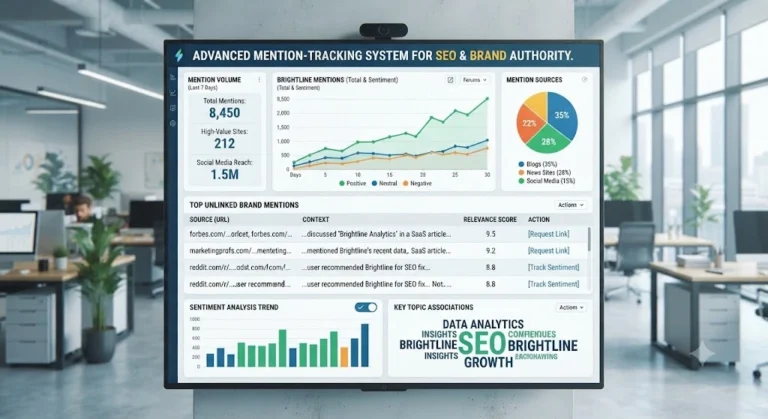
Good unlinked brand mentions SEO work starts with finding what already exists. Mention tracking doesn’t need expensive software to begin with.
Keep a simple sheet with the page URL, the date, whether it links to you, and the site’s relevance. That sheet becomes your outreach list.
Not every mention needs a link, but the ones on strong, relevant sites are worth a polite request. Write a short, friendly email, thank them for the mention, and suggest the exact page where a link would help their readers. Don’t demand it. Many writers say yes simply because nobody asked before.
While you grow mentions and links together, keep your link profile healthy too. Our guide on toxic backlinks shows which links to watch out for. And if you want the bigger picture of how this fits into your overall strategy, our pillar page covers the foundations.
The biggest mistake in unlinked brand mentions SEO is chasing quantity. Fifty mentions on irrelevant sites do less than five on respected sites in your industry. Other mistakes:
It is the practice of earning and monitoring mentions of your brand name on other websites, without a hyperlink, because those mentions can still support entity recognition and brand authority.
They can help indirectly. They support Google’s understanding of your brand and may reinforce authority, but Google hasn’t called them a confirmed direct ranking factor.
No. A backlink passes clear, direct value and sends referral traffic. A mention is a softer signal, and the two work best together.
Implied links are the idea that a brand mention may be treated as a link-like signal. It comes from a Google patent, but there is no confirmation of how it is used in practice.
Use Google Alerts, quoted brand searches with your own site excluded, social media and forum searches, and a mention-tracking tool if you need scale.
Co-citation is when your brand is named alongside other relevant brands or sources in the same context, helping search engines connect you to a topic.
Yes, when the site is relevant and trustworthy. Send a short, polite request that explains how the link helps their readers.
Negative mentions can hurt your reputation and the trust people have in you. Respond professionally and fix real issues instead of ignoring them.
There is no fixed number. Relevance and quality matter more than volume, so a few mentions on respected industry sites beat many on weak ones.
Social mentions are usually not a direct ranking signal, but they build awareness, drive branded searches and can lead to mentions on other websites.
Links will always matter, but they are not the whole story. Unlinked brand mentions SEO shows that being talked about, clearly and consistently, in the right places, adds real weight to your brand in search. Start by tracking what already exists, keep your brand name consistent everywhere, and politely ask for links where they make sense. Over time, these small signals add up.
Want help building your brand’s authority and online presence? Call us on 9718159724.