Voice Search and Local SEO: What “Near Me” Queries Actually Need
Voice Search and Local SEO: What “Near Me” Queries Actually Need Voice search local SEO is about making your business...
Read More → Not every backlink helps your site. Some quietly get it buried — and in link building, that difference decides whether your SEO investment compounds or collapses.
That’s the part most business owners don’t realize until it’s too late — a site can have hundreds of backlinks and still rank nowhere, because the wrong kind of links were doing the pointing. If you’re evaluating a white hat SEO link building service or trying to understand why an SEO campaign hasn’t moved the needle, the difference between white hat link building and black hat link building isn’t a technicality. It’s the difference between rankings that hold and rankings that vanish overnight.
White hat link building earns backlinks because a page deserves to be referenced — a genuinely useful guide, a real partnership, a mention that happened because someone found the content worth linking to. This is the foundation of ethical, Google-approved link building.
Black hat link building, on the other hand, manufactures links regardless of whether anyone would naturally point to that page. It’s a manipulative link building tactic designed to game rankings rather than earn them.
One approach builds domain authority over time through genuine link equity. The other borrows authority it hasn’t earned — and Google’s algorithm is built specifically to find and reverse exactly that kind of manipulation.
Search engines don’t grade backlinks by how they look on a report. They grade link quality by whether a human editor, writer, or site owner would have added that link naturally, without being paid, tricked, or automated into it.
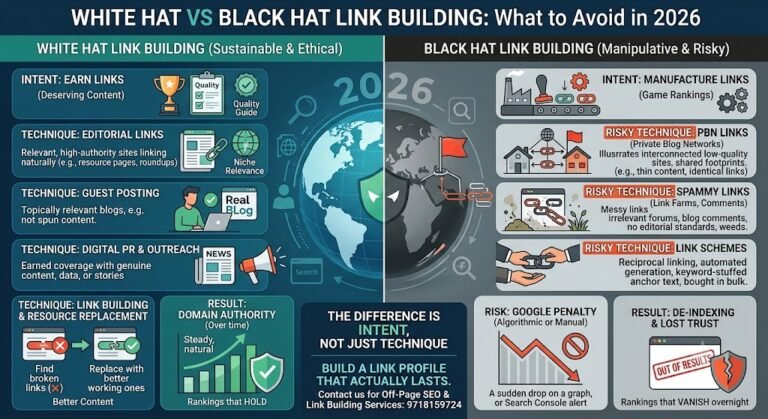
Legitimate, sustainable link building strategies include:
None of these white hat link building techniques scale as fast as buying links in bulk. That’s the tradeoff, and it’s the entire point — slow, earned link authority is exactly what doesn’t get penalized by a Google algorithm update.
Black hat SEO tactics exist because they promise fast rankings, and for a short window, they sometimes deliver a bump. The risk is what comes after.
PBN links (Private Blog Networks) are a common black hat link building example — a web of low-quality sites built purely to link back to a “money site,” with no real audience or purpose beyond passing link equity. Google has gotten aggressive at identifying PBN footprints: shared hosting patterns, thin content, and near-identical link profiles across the network.
Spammy backlinks from link farms, comment sections, forum signatures, or paid link networks are another red flag. These low-quality links come from sites with no topical relevance and no editorial standard — they exist purely to sell links, and Google’s spam-detection algorithms are specifically trained to spot that pattern.
Link schemes more broadly cover any arrangement built to manipulate search rankings rather than reflect genuine endorsement — excessive reciprocal linking, automated link generation, keyword-stuffed anchor text bought in bulk, or large-scale article spinning distributed across low-quality domains.
This is where the real cost of black hat link building sits. A site running on manipulative backlinks often looks fine for weeks or months — until it doesn’t.
The uncomfortable truth: by the time a Google penalty hits, the site owner has usually already paid twice — once for the bad links, and again for the link cleanup.
A few honest questions worth asking about any existing link building campaign:
If two or more of these are true, it’s worth a proper backlink audit before investing further in any SEO or link building campaign.
Sustainable link building isn’t about avoiding effort — it’s about pointing effort at things that hold up under scrutiny: content worth citing, relationships worth having, and outreach aimed at sites that would realistically link on merit. This is exactly the work covered under our Off-Page SEO & Link Building Services, where every backlink is built to survive an algorithm update, not just to pad a report.
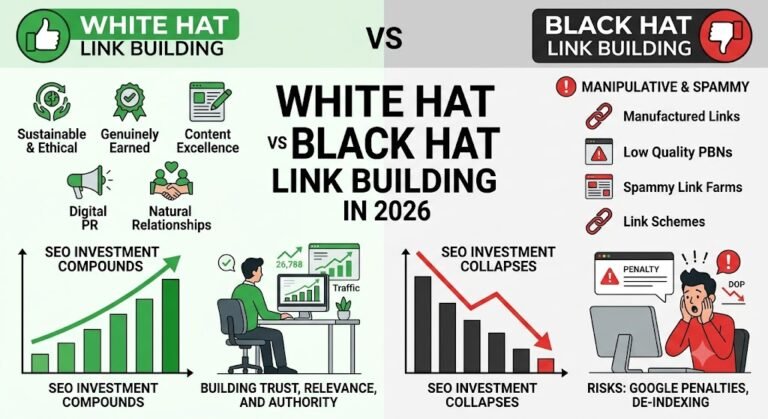
White hat links are earned through genuine relevance and value; black hat links are manufactured or paid for specifically to manipulate search rankings, regardless of real editorial merit.
Not instantly, but the risk compounds over time. Google continues refining its ability to spot private blog network patterns, and a PBN that works today can become a liability after the next algorithm update.
Paid links that pass PageRank without proper disclosure (like a nofollow or sponsored tag) violate Google’s link scheme guidelines regardless of the seller’s promises. Some paid placements are fine when properly tagged; guaranteed-ranking link packages almost never are.
It varies widely — a manual action tied to a small number of bad links might clear up within weeks of a cleanup and reconsideration request, while an algorithmic hit from widespread link spam can take several months to fully recover from.
Any pattern of link exchange, generation, or placement built primarily to influence search rankings rather than to genuinely help users — this includes excessive link exchanges, automated link building, and large-scale guest posting solely for links.
No — guest posting on relevant, quality publications is a legitimate white hat link building tactic. It becomes risky only when done at scale on low-quality, unrelated sites purely to insert links.
Ask directly where your backlinks are coming from. A legitimate link building agency will show you the actual linking domains. Vague answers, guaranteed rankings, or unwillingness to disclose sources are red flags.
Run a backlink audit, identify clearly manipulative or low-quality links, and use Google’s disavow tool for the ones you can’t get removed manually — ideally as part of a broader link cleanup rather than a one-time fix.
It’s a necessary step, but not always sufficient on its own — especially with manual actions, where a reconsideration request explaining the cleanup is usually also required.
It’s typically slower than black hat shortcuts — often a few months before meaningful ranking movement — but the results tend to hold and compound rather than collapse after an update.
Link building was never really about the number of backlinks — it’s about whether those links reflect real trust and authority. Black hat shortcuts can look like progress for a while, but the risk they carry, from algorithmic drops to full de-indexing, almost always costs more than the time they claimed to save. A white hat SEO link building service takes longer to show movement, but it’s movement that doesn’t get reversed by the next Google update.
If you want your backlink profile reviewed — or built the right way from here — call 9718159724 to talk through where your site actually stands.