Voice Search and Local SEO: What “Near Me” Queries Actually Need
Voice Search and Local SEO: What “Near Me” Queries Actually Need Voice search local SEO is about making your business...
Read More → Schema markup SEO 2026 comes down to one question: which structured data types still change how your pages appear in search, and which are just extra code? Implement JSON-LD for Organization, Article, Breadcrumb, Product and Review where they truly match your page content. Treat the rest as optional. Google no longer shows many of the rich results that used to make schema exciting.
This guide is part of our Technical SEO , and it is meant to help you decide what to implement rather than list everything schema.org offers.
Structured data is code that tells search engines, in a machine-readable format, what a page is about. A paragraph might mention a price, an author and a rating. Schema markup labels them so a crawler doesn’t have to guess.
Google has said structured data is not a direct ranking factor. It helps in other ways:
A tidy setup won’t rescue weak content, but it can remove guesswork for search engines.
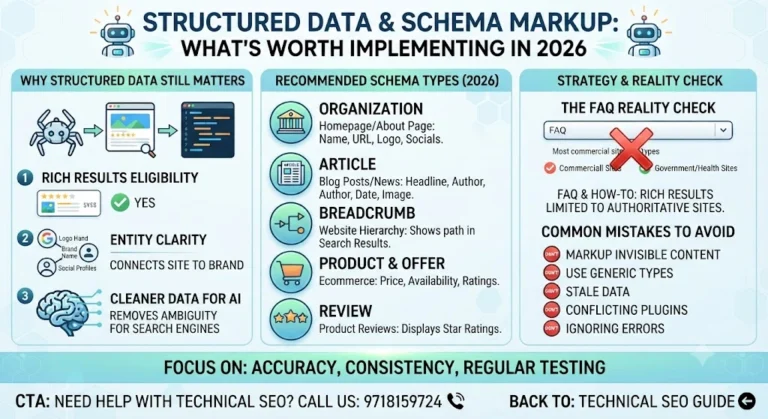
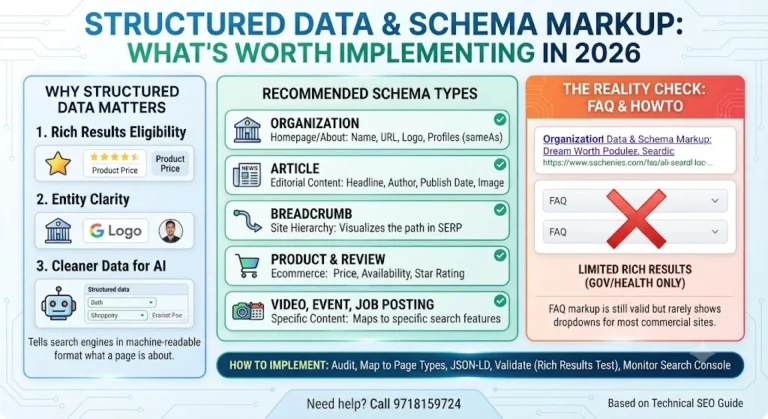
Put this on your homepage, or on an About page if that’s where your brand information lives. Include your name, URL, logo and official profiles through sameAs. It won’t create a flashy result, but it gives search engines a consistent definition of your business, and that consistency counts more as branded and AI-assisted search grow.
Use Article, NewsArticle or BlogPosting on editorial content, with the headline, author, publish date, modified date and image. Google’s documentation says Article markup has no special rich result attached to it, so this is a clarity and eligibility play. It is low effort, and it pairs well with real author pages.
Breadcrumb markup can turn a raw URL in search results into a readable path. Worth doing on any site with real hierarchy: categories, subcategories, product pages.
For ecommerce, this is still where structured data pays off most. Price, availability and rating information can show directly in results. The rule that matters is that every value in the markup must match what a visitor sees on the page.
These still map to specific search features. If you publish videos, run events or list jobs, they’re worth the work. If you don’t, skip them.
Here’s where many 2026 checklists are out of date. In 2023, Google limited FAQ rich results to well-known government and health websites, and HowTo rich results were also scaled back. For most commercial sites, adding FAQ markup no longer produces the expanded dropdowns in search.
So is it worthless? Not entirely:
What I’d avoid is spending hours on FAQ schema expecting a visible SERP change. Put that time into writing better answers instead.
Being eligible isn’t the same as being shown. Google looks for:
Marking up content that doesn’t exist, or exaggerating ratings, can lead to a manual action against your structured data.
Google has said structured data is not a direct ranking factor. Its value comes from rich result eligibility and clearer understanding of your content, which can improve click-through rate and visibility.
Organization, Article or BlogPosting, Breadcrumb and, for stores, Product with Offer and Review. Add Video, Event or JobPosting only if you publish that content type
For most websites, no. Google restricted FAQ rich results to authoritative government and health sites in 2023. The markup is still valid, but don’t expect dropdowns in search.
JSON-LD. Google recommends it, and it’s easier to maintain because it lives in one script block rather than being mixed into your page HTML.
Yes. Markup that misrepresents visible content can trigger a manual action, and Google may stop showing rich results for the affected pages.
Use Google’s Rich Results Test for eligibility and the Schema Markup Validator for general syntax. Then watch the enhancement reports in Search Console.
Not always. Most CMS platforms and SEO plugins can generate common types automatically. A developer helps with custom types or template-level problems.
It depends on crawl frequency, so it can take days or weeks. Requesting indexing in Search Console can speed up recrawling, but display is never guaranteed.
Google hasn’t promised any direct link, but clear entity information and well-structured content make your pages easier to interpret. Treat it as a supporting signal, not a shortcut.
After any redesign or CMS change, and at least a couple of times a year, since Google adds and retires rich result features. Always confirm current support in Google’s documentation.
Schema markup SEO 2026 is about being selective. Start with Organization, Article and Breadcrumb markup, add Product and Review data if you sell online, and validate everything against what’s visible on the page. Don’t burn time on retired features, especially FAQ and HowTo markup, when the rich results are gone for most sites. Accuracy, consistency and regular testing beat covering every schema.org type.
If you’d like help auditing your structured data or fixing errors in Search Console, call us on 9718159724 and we’ll go through it with you. For the bigger picture, head back to our