Voice Search and Local SEO: What “Near Me” Queries Actually Need
Voice Search and Local SEO: What “Near Me” Queries Actually Need Voice search local SEO is about making your business...
Read More → If your website has dozens of pages but none of them rank consistently, the problem is rarely the content itself — it’s usually how those pages are connected (or not connected) to each other. Silo structure SEO services exist to fix exactly this: organizing a website into clearly defined topic clusters so search engines can understand what you’re actually an authority on, instead of guessing from a scattered pile of unrelated pages.
A silo is a group of pages built around one central topic, all linked together in a deliberate, hierarchical way. Picture a pillar page sitting at the top — say, a broad service page — with several supporting pages underneath it, each covering a specific sub-topic in more depth. Those supporting pages link up to the pillar, the pillar links down to them, and pages within the same silo link sideways to each other. Pages that belong to a different topic don’t get linked in, at least not without a very good reason.
This is different from how most websites end up looking by default: a homepage, a blank “Services” dropdown, a blog with posts linked wherever it seemed convenient at the time, and internal links scattered based on whatever the writer remembered to add. That kind of structure doesn’t tell Google anything about depth. Silo structure does.
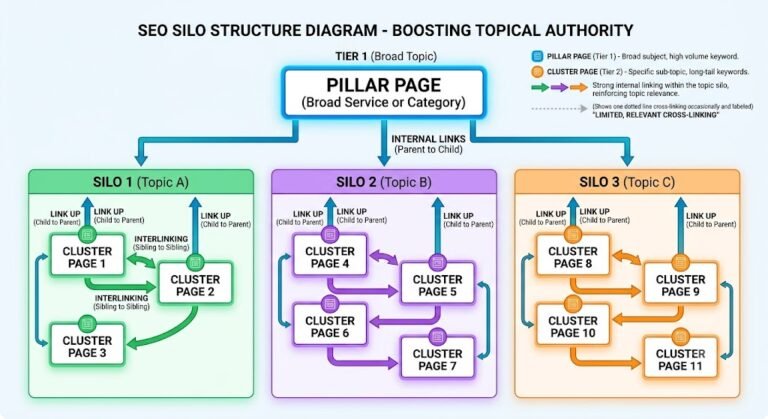
These two terms get used almost interchangeably, and there’s good reason for that — they’re built on the same core idea. A pillar cluster content strategy usually refers to the content side: one comprehensive pillar page plus several cluster articles that each target a specific long-tail angle, all interlinked. Silo structure is the broader architectural version of the same principle, and it can apply to service pages, category pages, and location pages just as much as blog content.
In practice, most well-planned SEO content architecture uses both at once: pillar-cluster logic for the blog content, and silo logic for how service and category pages are organized underneath the main navigation.
Start by mapping your core topics before you map your pages. If “On-Page SEO” is one core topic, list out every realistic sub-topic someone might search for — title tag optimization, internal linking, silo structure itself, content depth, schema markup — before deciding what to build. Each of those becomes a page that lives inside the same silo.
Next, get the internal linking direction right. The pillar page links down to each cluster page, each cluster page links back up to the pillar, and cluster pages within the same silo link to each other where it’s genuinely relevant to the reader — not forced in for the sake of a link count. This page, for example, sits inside the On-Page SEO silo and connects back to the broader On-Page SEO Services pillar page, since silo structure is one specific technique within that wider discipline.
Finally, keep the silo closed unless there’s a strong reason to cross-link. If a page about silo structure suddenly links out to a completely unrelated topic like local citations, it dilutes the signal you’re trying to build. Cross-linking has its place, but it should be the exception, planned deliberately — not the default.
One of the fastest ways to undo the benefit of a silo is keyword cannibalization — having two or more pages on the site competing for the same keyword. This happens often when a pillar page and a cluster page both get optimized around near-identical phrasing, and Google ends up unsure which one to rank, sometimes suppressing both. A clean silo actually prevents this by design: the pillar targets the broad term, and each cluster page is scoped to a distinct, narrower angle, so there’s no overlap to begin with. If you’re auditing an existing site, check for pages targeting the same primary keyword before building new silo pages around it.
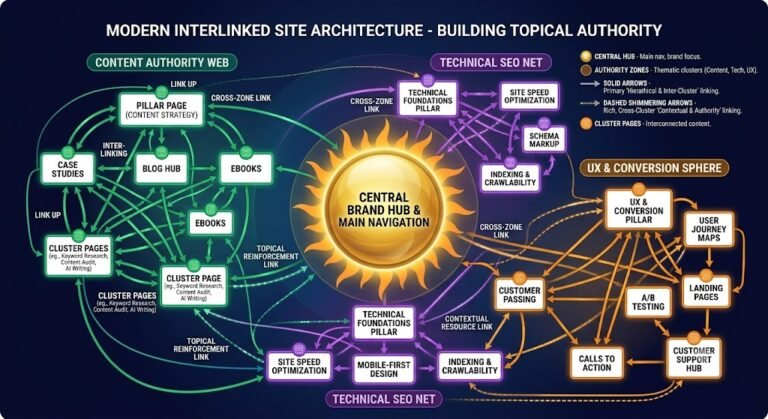
A few patterns are worth watching for: pages that rank on page two and never move despite decent content, blog posts published on-topic but sitting as orphan pages with almost no internal links pointing to them, or a navigation menu that doesn’t reflect any real topic grouping. None of these are content quality problems on their own — they’re structural problems, and no amount of rewriting fixes them without also fixing the linking architecture underneath.
It’s a way of organizing a website’s pages into topic-based clusters, where a central pillar page links to and from several related sub-topic pages, keeping internal linking focused within that one subject.
They overlap heavily. Pillar-cluster is usually the content-planning side of the idea; silo structure is the site-wide architectural version, applied to navigation and internal linking as well as content.
It doesn’t guarantee rankings on its own, but it strengthens topical authority signals and makes it easier for both search engines and users to find related content, which supports rankings for the pages involved.
There’s no fixed number. A pillar page plus a handful of genuinely distinct cluster pages is enough to start; the right number depends on how many real sub-topics your subject actually has.
Yes — if two pages in the same silo end up targeting the same primary keyword instead of distinct angles, they’ll compete with each other. Clear topic separation before building pages avoids this.
They can be, as long as they’re on the same core topic. A service page can sit as the pillar with supporting blog posts as the cluster content underneath it.
Occasionally, when it’s genuinely useful to the reader and directly relevant — but it should be the exception, not a habit, or it weakens the topic signal you’re building.
This varies by site size, crawl frequency, and competition, so there’s no fixed timeline — but internal restructuring is usually noticed by crawlers faster than earning new external links.
Not necessarily. Existing pages can often be reorganized through updated internal links and a clearer navigation hierarchy without rebuilding the pages themselves.
It’s one part of a broader on-page SEO approach — alongside things like title tags, content depth, and schema markup — that together shape how well a site’s pages are understood and ranked.
If you’re not sure whether your current site is helping or hurting your rankings, the fastest way to find out is a direct look at your internal linking and page hierarchy. Call 9718159724 to talk through your site’s structure and get a clear, practical plan for organizing it into proper topic silos.