Voice Search and Local SEO: What “Near Me” Queries Actually Need
Voice Search and Local SEO: What “Near Me” Queries Actually Need Voice search local SEO is about making your business...
Read More → Search intent on-page SEO means building every visible element of a page (title, headings, content format and call to action) around what the searcher actually wants to do, not just the words they typed. When the page matches the goal behind the query, Google has a reason to rank it. When it doesn’t, no amount of keyword tweaking saves it. This guide shows you how to read intent, match your content to it, and fix mismatches. It is part of our complete On-Page SEO pillar guide.
Search intent is the goal behind a query. Someone typing “how to change a car tyre” wants steps. Someone typing “tyre shop near me” wants an address and a phone number. The topic is the same, but the right page is completely different. Search intent on-page SEO starts with accepting that difference before you touch a single tag.
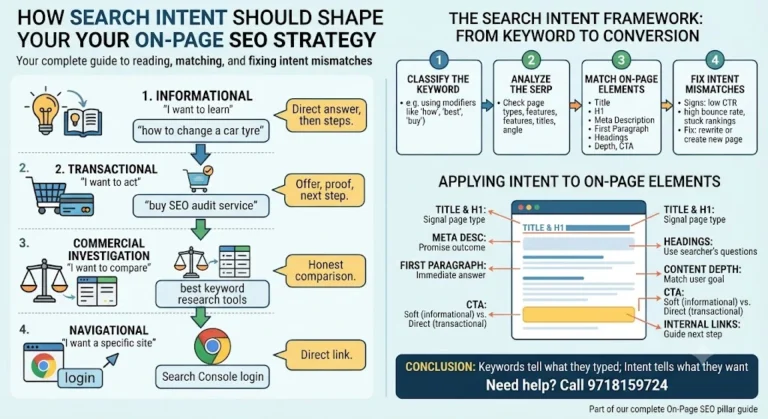
Most queries fall into four buckets:
Informational pages need a direct answer near the top, then explanation and examples. Transactional pages need the offer, the proof and the next step visible without scrolling through a long essay. Commercial pages need honest comparisons.
The most common failure is a 2,000-word explainer sitting on a keyword where people are ready to buy. Good search intent on-page SEO fixes this by deciding the page’s job first and the word count second.
Modifiers give the intent away. “How”, “why”, “guide” and “what is” point to informational. “Buy”, “price”, “near me”, “hire” and “quote” point to transactional. “Best”, “top”, “vs” and “review” point to commercial investigation. Label the keyword first, as search intent on-page SEO requires, then plan the page. If a keyword has no clear modifier, let the SERP decide.
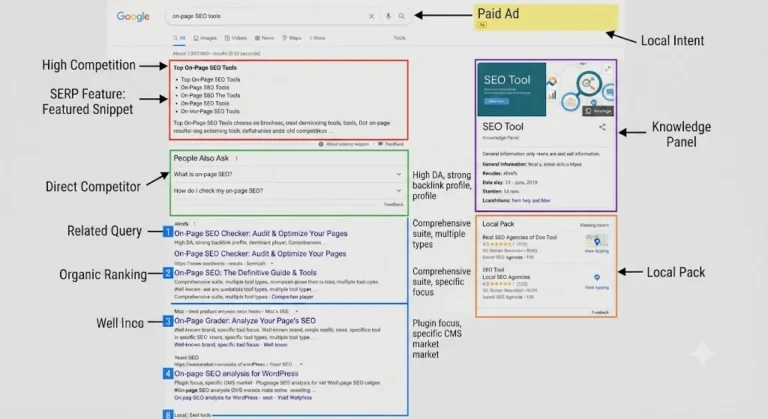
Google is already telling you what it believes users want. Search your target keyword in an incognito window and check:
If all ten results are step-by-step tutorials and you are publishing a sales page, that is an intent mismatch. Search intent on-page SEO treats the top results as the brief for what the page must be, then finds the gap they leave.
Format is part of search intent on-page SEO. A “how to” query wants numbered steps. A comparison query wants a table. A “what is” query wants a two-sentence definition first. A local query wants your address, hours and phone number close to the top. When the format matches what searchers expect, they stay, and that behaviour supports your rankings. When it doesn’t, they go back to the results within seconds.
This is where search intent on-page SEO becomes practical.
Title tag and H1: signal the page type. “How to…” for guides, “Best… in 2026” for comparisons, a service plus location for transactional pages.
Meta description: promise the exact outcome the searcher wants, in plain words.
First paragraph: answer the core question immediately. Informational readers should get the answer in the first couple of sentences. Transactional readers should see what you offer and how to take action.
Headings: use the questions people really ask, not clever labels.
Depth: match it to the intent. A definition page doesn’t need 3,000 words, and a buying guide can’t be thin.
Call to action: informational pages get a soft next step, such as a related guide. Transactional pages get a direct one, such as call, book or request a quote.
Internal links: link to the next logical step in the reader’s journey. For more on structuring these connections, read our guide on internal linking strategy.
Intent mismatch SEO problems tend to show up in patterns:
The fix is either to rewrite the page to fit the dominant intent or to create a separate page for the other intent. Don’t force one URL to serve two goals, because the page ends up serving neither well and your own pages may start competing with each other.
Search intent is the reason behind a search query, meaning what the person wants to find, learn, compare or do. Google tries to rank pages that satisfy that reason.
On-page elements such as titles, headings and content format only work if they fit what searchers expect. Search intent on-page SEO makes sure your optimisation effort supports the goal behind the query instead of working against it.
Informational intent means the user wants knowledge, such as a guide or explanation. Transactional intent means the user is ready to buy, book or sign up. The two need different page layouts, depth and calls to action.
Look at the modifiers in the query, then search it on Google and study the top results. The page types, titles and SERP features show what Google believes users want.
Informational, navigational, commercial investigation and transactional. Some queries blend two of them, in which case the SERP shows which one dominates.
It happens when your page type or content doesn’t match what searchers expect for that query, for example a product page targeting a “how to” keyword.
Rarely. Closely related intents can sometimes share a page, but mixed goals usually weaken both. A separate page per intent is safer and easier to optimise.
Copy the format pattern that dominates the results, whether that is steps, a comparison table, a definition or a local service layout, and then improve on it with more specific detail.
Yes. Both should tell searchers exactly what type of page they will land on. A title that promises a guide but leads to a sales page hurts clicks and satisfaction.
Check it whenever rankings drop or SERPs change, and review key pages a couple of times a year. Intent can shift as Google’s results change, so search intent on-page SEO is an ongoing check and not a one-time task.
Keywords tell you what people typed. Intent tells you what they want. Search intent on-page SEO connects the two by letting the query decide your page type, format, depth and call to action. Classify the keyword, study the SERP, match the format, and fix mismatches instead of adding more keywords. Do this consistently and your pages will earn clicks, hold attention and rank more steadily.
Need help matching your pages to search intent? Call 9718159724.