Voice Search and Local SEO: What “Near Me” Queries Actually Need
Voice Search and Local SEO: What “Near Me” Queries Actually Need Voice search local SEO is about making your business...
Read More → ChatGPT and Perplexity cite pages that answer the question directly, sit on sites they can crawl and trust, and contain passages that are easy to lift cleanly into an answer. Neither company publishes an exact formula, but that pattern holds up across what both describe publicly and what site owners observe. If you’re working on perplexity search optimization, the aim isn’t to trick a ranking system. It’s to become the page an AI can quote without second-guessing.
Below, we break down how each engine appears to select sources, what citation-worthy content looks like in practice, and where structured data, brand mentions and E-E-A-T signals fit in.
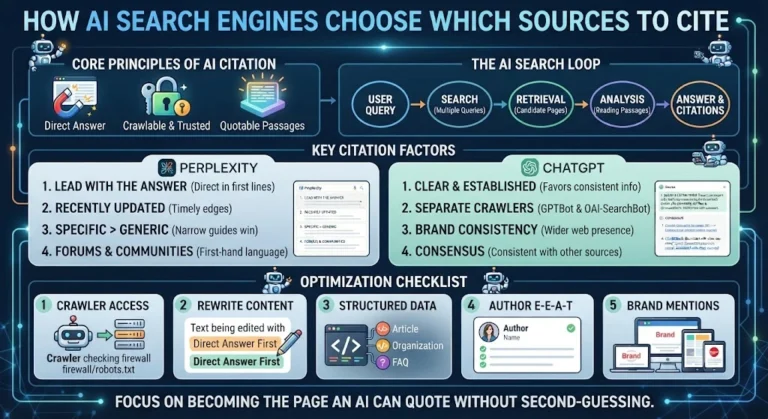
Both tools follow a similar loop. You ask a question, the system turns it into one or more search queries, pulls back a set of candidate pages, reads the relevant passages, and writes an answer with links to the pages it leaned on. Selection happens twice: first when pages are retrieved, then again when the model decides which passages are worth citing.
That two-step process explains something most site owners miss. Being retrievable isn’t enough. A page can be pulled in and still never cited if the useful answer is buried in paragraph nine, wrapped in vague copy, or stated more clearly by another source.
Perplexity is built around live retrieval. It searches the web for most queries and attaches numbered citations to specific claims, which makes it the easier of the two to study. You can see exactly which pages made the cut.
A few patterns show up when you look at those citations:
Practical perplexity search optimization begins with access. PerplexityBot is the crawler Perplexity documents for its search index, so check that your robots.txt, firewall and CDN rules aren’t blocking it by accident. It’s a boring fix, and it quietly rules out a surprising number of sites.
ChatGPT doesn’t search every time. It answers from training when it can and browses when the question needs current or verifiable information. When it browses, it draws on search results and shows its sources next to the answer.
One distinction matters for visibility: OpenAI uses separate crawlers. GPTBot relates to training data, while OAI-SearchBot is tied to surfacing sites in ChatGPT’s search features. Blocking GPTBot doesn’t remove you from search results, but blocking OAI-SearchBot can. Plenty of sites blocked every AI bot in one sweep and never went back to review it.
Perplexity search optimization and ChatGPT visibility overlap heavily, but the crawler rules differ. Beyond access, ChatGPT tends to favor sources that are clear, well established and consistent with what other sources say. A page making a claim nobody else supports is less likely to be used. That’s why a proper chatgpt search visibility service looks at more than your own pages. It checks how your brand shows up across the wider web too.
Citation-worthy content is content an AI can quote without needing the rest of the page for context. In perplexity search optimization, this is where most of the real work sits, and it has practical consequences:
Clarity beats sophistication. Write the way a knowledgeable person explains something to a colleague.
Structured data doesn’t guarantee a citation, and nobody outside these companies can say how heavily it’s weighted. What it does is remove ambiguity: who published the page, who wrote it, what it’s about, and which questions it answers.
For perplexity search optimization on most service and blog pages, the useful types are Article, Organization, Person (for authors), FAQPage where you genuinely have FAQs, and BreadcrumbList. Keep markup honest. It has to match what’s visible on the page, and mismatched markup is worse than none. Pair it with clean HTML: a sensible H1 to H3 order, real lists, real tables and descriptive anchor text.
AI engines don’t judge your website in isolation. They also see how your brand is described elsewhere: industry publications, directories, podcasts, community threads, comparison articles. A brand that appears consistently, with the same name, the same category and the same description, is easier for a model to trust.
Unlinked mentions matter more here than they ever did in classic SEO, because the model reads the text, not only the link graph. So part of perplexity search optimization happens outside your site, in the places your buyers and journalists actually read.
E-E-A-T (experience, expertise, authoritativeness, trustworthiness) comes from Google’s quality guidelines, not from ChatGPT or Perplexity. The underlying idea still transfers to perplexity search optimization, since any engine wants sources that are unlikely to mislead.
Show it plainly:
Don’t invent credentials to look authoritative. Thin or fake-looking trust signals are easy to spot and tend to backfire.

These are the mistakes that most often hold back perplexity search optimization:
Here’s a workable order to tackle it:
Some of this you can do in-house. The audit side is where teams usually stall: crawl access, brand consistency, and gap analysis across dozens of prompts. An ai search ranking service handles that at scale and keeps testing as answers change. If you’d like to see how all these pieces fit into one plan, our pillar page on AIO/GEO Optimization Services covers the full approach and is the natural next read after this guide.
It’s the practice of making your pages easy for Perplexity to find, trust and quote. That means allowing its crawler, answering questions directly, marking up your content clearly, and building a consistent brand presence across the web.
Often there’s overlap, but not always. Perplexity leans heavily on live retrieval and shows numbered citations, while ChatGPT decides case by case whether to browse. Testing the same question in both is the fastest way to see the difference for your niche.
If you want to appear in AI search answers, yes, at least the search-related ones like PerplexityBot and OAI-SearchBot. Blocking training crawlers such as GPTBot is a separate decision and doesn’t automatically hide you from search features.
It helps engines understand who wrote a page and what it covers, but it’s not a guarantee and its exact weight isn’t public. Treat it as a way to reduce ambiguity, not as a shortcut.
They help models recognize your brand as a real, established entity. Consistent mentions on trusted third-party sites, using the same name and description, make it easier for an engine to trust and reference you.
The framework is Google’s, but the principle carries over. Named authors, firsthand detail, cited facts and clear ownership all make a page a safer source to quote.
There’s no fixed timeline. Crawl fixes and page rewrites can show up within weeks for live-retrieval tools, while brand mentions and authority build more slowly. Re-test the same prompts monthly to track movement.
Run your target questions in ChatGPT and Perplexity regularly and record which domains appear. Keep a simple sheet with the prompt, the date, the engine and the cited sources so you can spot trends.
At minimum: a crawler-access review, an audit of your key pages for direct answers and structure, a check of your brand’s presence off-site, and repeatable prompt testing so progress is measurable.
It can be, particularly if you lack time to run audits and re-testing yourself. Start with the perplexity search optimization checklist above, and consider outside help once you know which gaps are biggest.
ChatGPT and Perplexity don’t reward tricks. They cite pages that are accessible to their crawlers, clear enough to quote, backed by real people, and supported by a brand that’s described consistently across the web. Get the access basics right, write answer-first content, add honest structured data, and build mentions beyond your own site. Steady perplexity search optimization done this way also makes your content better for human readers, which is the part that keeps paying off.
If you’d like help turning this into an actual plan for your site, call 9718159724 and talk it through.