Voice Search and Local SEO: What “Near Me” Queries Actually Need
Voice Search and Local SEO: What “Near Me” Queries Actually Need Voice search local SEO is about making your business...
Read More → If your website traffic has flatlined despite regular posting, the problem is usually not content quality — it’s on-page structure. Businesses looking for on page seo services in Delhi are almost always dealing with the same root issue: pages that read fine to humans but confuse search engines about what the page is actually about. This checklist walks through every on-page factor that actually moves rankings in 2026, without the fluff that most “SEO checklists” pad themselves with.
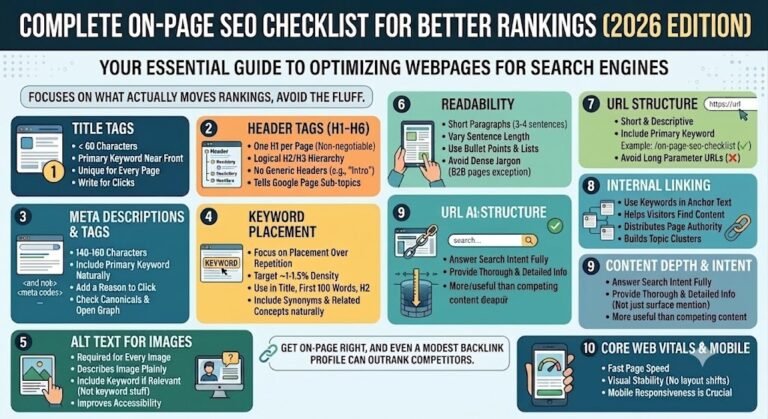
On-page SEO is everything you control directly on a webpage — the code, the copy, the structure — that helps search engines understand and rank your content. It’s different from off-page SEO (backlinks, mentions, PR) and technical SEO (crawlability, site speed, indexing), though the three overlap constantly. Get on-page right, and even a modest backlink profile can outrank a competitor sitting on hundreds of low-quality links.
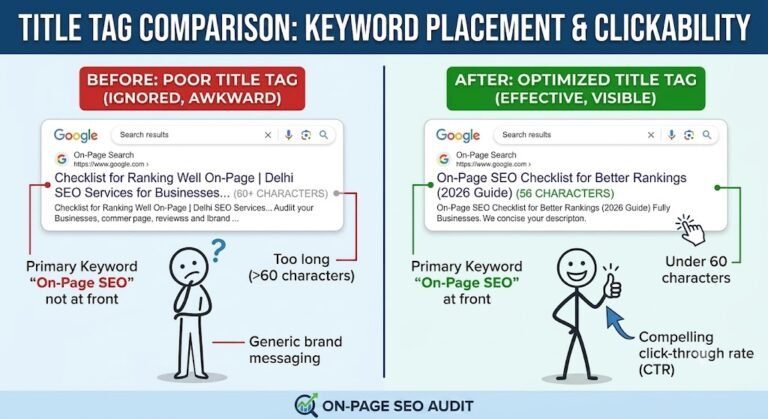
Your title tag is still one of the strongest on-page ranking signals, and it’s the first line a searcher sees on the results page. A few rules that get ignored more often than they should:
Think of your header tags as a table of contents for both readers and crawlers. One H1 per page — that’s non-negotiable — followed by a logical H2/H3 hierarchy that breaks the page into scannable sections.
Headers aren’t just formatting. They tell Google what sub-topics your page covers, which directly affects whether you show up for related long-tail searches. If your H2s are generic (“Introduction,” “More Info,” “Conclusion”), you’re wasting real estate that could be doing keyword work instead.
Meta descriptions don’t directly influence rankings, but they influence click-through rate — and CTR is one of the strongest indirect signals Google uses. Good meta tag optimization means:
Beyond meta descriptions, check your canonical tags, Open Graph tags, and robots meta tags. A misconfigured canonical tag alone can quietly cannibalize rankings across an entire site without any obvious symptom.
Keyword density used to be a numbers game. It isn’t anymore — but that doesn’t mean keywords stopped mattering, it means placement matters more than repetition. A workable target is roughly 1–1.5% density for your primary term, spread naturally across the page rather than clustered in one paragraph.
Practical placement checklist:
Every image on your page needs alt text — not for SEO alone, but because it also makes your site usable for people relying on screen readers. Good alt text describes what’s actually in the image in plain language, and where relevant, includes a keyword without turning the description into a keyword dump. “SEO checklist infographic showing title tag and header tag structure” is useful. “SEO SEO checklist Delhi SEO services” is not — and Google can tell the difference.
Readability affects how long visitors stay, how much they scroll, and whether they bounce straight back to the search results — and all of that feeds back into rankings indirectly through engagement signals. Practical fixes:
Short, descriptive URLs that include the primary keyword outperform long, parameter-heavy ones. /on-page-seo-checklist beats /blog/post?id=4521&cat=seo every time — both for users deciding whether to click, and for crawlers trying to understand page hierarchy.
Internal links do two jobs: they help visitors find related content, and they help Google understand which pages on your site matter most. If this page is part of a broader content plan, it should link back to the main On-Page SEO Services pillar page, and that pillar page should link forward to supporting content like this one — building a clear topic cluster instead of a scattered set of unrelated posts.
A checklist that lists ten factors in one line each will lose to a page that actually explains each factor with enough detail to be useful. Before publishing, ask: does this page fully answer what someone searching “on page seo services in Delhi” actually wants to know — or does it just mention the topic in passing? Search intent match is arguably the single biggest on-page factor that has nothing to do with tags or code.
Technically adjacent to on-page SEO, but impossible to separate from it in 2026: page speed, layout stability, and mobile responsiveness all affect how Google evaluates a page’s quality. A perfectly optimized title tag on a page that takes six seconds to load on mobile is fighting an uphill battle.

On-page SEO covers everything on your own website — content, tags, structure, internal links. Off-page SEO covers external signals like backlinks, brand mentions, and social signals that happen outside your site.
Review title tags, meta descriptions, and content depth at least every 6 months, or sooner if rankings drop or search intent for your keywords shifts.
It matters less than placement and context now. A natural 1–1.5% density with the keyword appearing in the right spots (title, intro, one subheading) works better than chasing an exact percentage.
Exactly one. Multiple H1s confuse both users and search engines about the page’s main topic.
Yes — for accessibility compliance and for image search visibility, every meaningful image needs descriptive alt text.
It significantly improves your chances, but it works alongside off-page and technical SEO. A well-optimized page with zero authority behind it will still struggle against established competitors for competitive terms.
Around 140–160 characters — long enough to be informative, short enough to avoid truncation on the results page.
Better readability keeps visitors on the page longer and reduces bounce rate, both of which are engagement signals search engines factor into rankings.
Yes — local intent pages should include location-specific keywords naturally in titles, headers, and body copy, plus consistent NAP (name, address, phone) information across the site.
Typically 4–12 weeks, depending on how competitive the keyword is and how frequently the page was crawled before changes were made.
A checklist tells you what to fix. An audit tells you what’s actually broken on your specific site — which title tags are underperforming, which pages are cannibalizing each other, and where your content is falling short of search intent. If you’d rather have this handled than DIY it across dozens of pages, call 9718159724 for a full on-page SEO audit and fix.