Voice Search and Local SEO: What “Near Me” Queries Actually Need
Voice Search and Local SEO: What “Near Me” Queries Actually Need Voice search local SEO is about making your business...
Read More → A solid internal linking strategy SEO plan has no magic number, but the rule is simple: add a link only when it helps the reader take a useful next step. For most blog posts, that works out to roughly 3 to 10 contextual links in the body. Go far beyond that without a clear reason and your links start competing with each other instead of helping each other.
Google no longer publishes a hard cap like the old “100 links per page” guideline. What it does say is to keep links reasonable and useful. So the real question isn’t “how many,” it’s “how many can this page carry before each one stops meaning anything.”
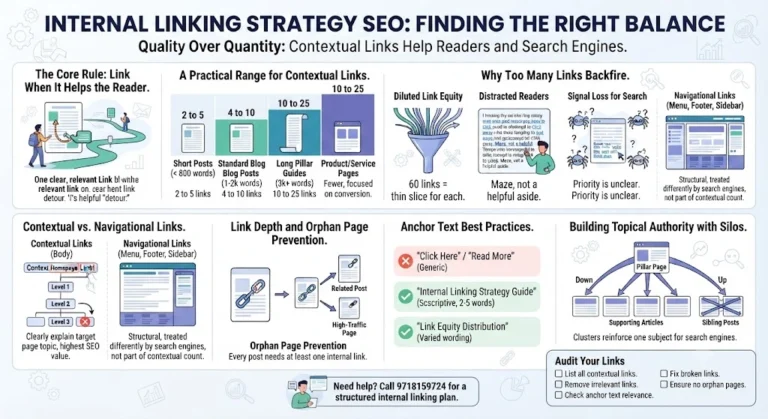
Every link on a page is a small vote for the page it points to. Spread those votes across 60 destinations and each one gets a thin slice. That’s the core problem with poor link equity distribution, and it’s why any internal linking strategy SEO plan needs a ceiling: the pages you actually want to rank get the same weight as a random tag page or an old post nobody reads.
There’s a reader problem too. A paragraph with four links in two sentences gives people four reasons to leave before they finish your point. Links should feel like a helpful aside, not a maze.
And there’s a signal problem. When half the words in a section are blue, search engines have a harder time telling which links matter most. Clean pages make your priorities obvious.
Treat these ranges as starting points for your internal linking strategy SEO checklist, not rules. Adjust to the length and purpose of the page.
A quick sanity test: if you removed a link and the paragraph read exactly the same, that link probably wasn’t earning its spot.
Your menu, footer and sidebar already contain dozens of links. Those are navigational, and search engines generally treat them differently from links placed inside the body copy. Contextual links, the ones inside sentences, carry the clearest meaning because the surrounding words explain what the target page is about.
When you count links on a page, count them separately. A page can have 80 navigation links and still have a tidy, well-judged set of 6 contextual ones. Your audit should focus on that second group, because that’s where your choices actually show up.
Link depth is how many clicks it takes to reach a page from your homepage. Important pages buried five or six clicks deep tend to get crawled less often and rarely build authority. A good rule is to keep anything you want to rank within three clicks of the homepage.
Orphan page prevention is the other half. An orphan page has no internal links pointing to it, so crawlers and readers can only find it through a sitemap or a direct URL. Every new post should receive at least one link from an existing, relevant page, ideally from something that already gets steady traffic. Publishing a post and forgetting to link to it is where many an internal linking strategy SEO plan quietly falls apart, and it’s easy to fix.
Anchor text tells both readers and search engines what to expect on the other side. Inside any internal linking strategy SEO plan, a sound anchor text strategy comes down to a few habits:
This is one of the internal link best practices that costs nothing and pays off on every page you touch.
A silo linking structure groups pages by topic. A pillar page covers the broad subject, and supporting posts go deep on individual questions. Supporting posts link up to the pillar, the pillar links down to them, and cross-links between siblings happen only where the topics genuinely overlap.
That’s how topical authority builds, and it’s the backbone of a lasting internal linking strategy SEO approach. Search engines see a tight cluster of connected pages that all reinforce one subject, rather than a scattered site where every page links to everything.
This post, for example, sits inside the internal linking cluster. It should point up to the main pillar guide on internal linking, and it should cross-reference the article on content depth vs length, because a page’s link count and its depth are closely related: a long, detailed page can support more links, while a thin one can’t.
You don’t need expensive tools to test your internal linking strategy SEO on a single page. Work through these steps:
Do this for your highest-traffic pages first. Cleaning up a few key pages usually improves things faster than touching everything at once.
In any internal linking strategy SEO plan, most blog posts do well with 3 to 10 contextual internal links. Longer guides can hold more, provided each link is relevant to the sentence around it.
No. Google removed the old fixed guideline and now advises keeping the number reasonable and useful. Quality and relevance matter more than a count.
They can. Too many links dilute link equity distribution, distract readers and make it harder for search engines to see which pages you consider important.
They exist on the page, but contextual links inside the body are the ones you should manage carefully. Audit those separately from menu and footer links.
Once is usually enough. A second link is fine in a very long article if it appears far from the first and genuinely helps, but repeating it in every section adds nothing.
A short, descriptive phrase that tells the reader what they’ll find, such as “link equity distribution” or “orphan page checklist.” Avoid generic phrases like “click here.”
It’s a page with no internal links pointing to it. Crawlers may struggle to find it and it receives no authority from the rest of your site, so it rarely ranks well.
Aim to keep pages you want to rank within three clicks of the homepage. Deeper pages tend to be crawled less often and get less internal authority.
Yes, from supporting posts in the same topic cluster. Keep it natural and relevant, and don’t force pillar links into unrelated content.
Review them whenever you publish a new post, and run a fuller check every few months. Update old posts to link to new content so nothing ends up orphaned.
The best internal linking strategy SEO can offer isn’t a number, it’s a habit: link when it helps the reader, use clear anchor text, keep important pages close to the homepage, and make sure no page is left without a link pointing to it. Do that within a tidy silo and your pages support each other instead of fighting for attention.
If you’d like help reviewing your site’s link structure or building a cleaner content cluster, call 9718159724.