Voice Search and Local SEO: What “Near Me” Queries Actually Need
Voice Search and Local SEO: What “Near Me” Queries Actually Need Voice search local SEO is about making your business...
Read More → If your pages aren’t ranking, the problem usually starts before you write a single word — at keyword research. A proper SEO keyword research service doesn’t just hand you a list of words; it maps out what your audience is actually typing into Google, why they’re typing it, and how competitive each term is to rank for. Get keyword research wrong and even well-written pages sit buried on page three. Get it right, and on-page SEO becomes far easier, because you’re writing for terms people genuinely search.
This guide walks through the exact keyword research process — from seed topics to search intent to a full keyword map — so your on-page SEO is built on solid ground instead of guesswork.
On-page SEO — your titles, headings, body content, internal links — only works when it’s built around the right keyword target. Optimizing a page for a keyword nobody searches, or one dominated by giant brands, wastes the effort. Keyword research first tells you which battles are winnable and which keywords will actually bring visitors who convert.
This is also where most DIY keyword research attempts go wrong. People pick keywords based on gut feeling — “this sounds like what customers would search” — instead of checking real search behavior. A structured keyword research process fixes that.
Before opening any keyword research tool, list out the core topics your business actually serves. If you run an on-page SEO agency, your seed topics might be technical audits, content optimization, or metadata fixes. Specific keywords come later — seed topics keep your keyword research focused instead of scattered across a hundred unrelated terms.
This is the step people skip in keyword research, and it costs them rankings. Search intent research means figuring out what someone actually wants when they type a phrase — are they trying to learn something, compare options, or ready to buy? A term like “what is on-page SEO” is informational; someone typing “on-page SEO services near me” is ready to hire. Writing a sales page for the first keyword, or a dictionary-style explainer for the second, both fail — not because the content is bad, but because it doesn’t match the intent behind the search.
Google’s own ranking pages are the best clue for search intent. If the first page is full of blog explainers, that’s an informational keyword. If it’s full of service pages with pricing and contact forms, that’s a transactional keyword. Match the content format to the intent, not just the topic.
Guessing search volume doesn’t work in keyword research. Tools like Semrush and Ahrefs show actual monthly search numbers, keyword difficulty scores, and the exact keywords competitors already rank for. Google’s own Keyword Planner and the “People Also Ask” boxes on search results are free ways to expand your keyword list further.
Two numbers matter most in keyword research:
Long tail keywords — longer, more specific phrases like “keyword research checklist for local service pages” instead of just “keyword research” — bring fewer visitors per term, but they convert better and are far easier to rank for. If your site is new or doesn’t have strong authority yet, chasing broad, one-word keywords is usually a losing game. Long tail keywords let you build rankings and traffic while you’re still establishing authority, and they often match commercial or transactional intent more precisely than short, generic keywords.
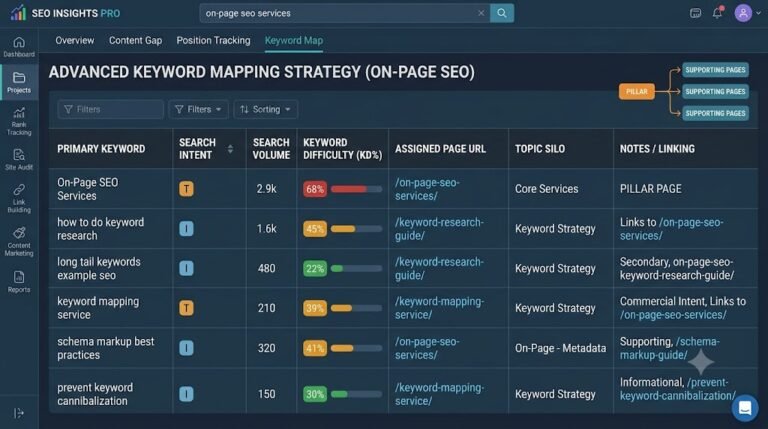
A flat spreadsheet of keywords doesn’t tell you which page each keyword belongs to. A proper keyword mapping service assigns each keyword — primary and secondary — to a specific page on your site, based on topic and intent, so you’re never writing two pages competing for the same keyword (a problem called keyword cannibalization). Keyword mapping also reveals content gaps: topics your competitors cover that you haven’t touched yet.
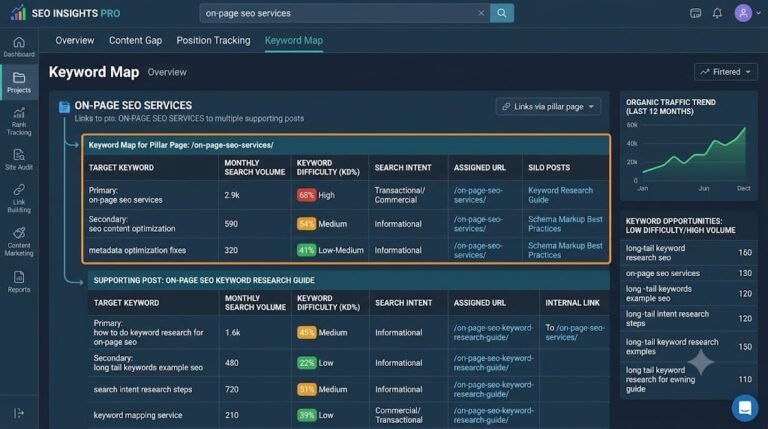
A simple keyword map looks like this: one primary keyword per page, two to four supporting secondary keywords, and a note on which pillar or hub page it should link back to. This keeps your keyword strategy structured instead of a pile of disconnected blog posts.
Once your keyword map is built, organize keywords into topic clusters — commonly called silos. All your on-page SEO-related keywords link to and from a central pillar page (for example, your On-Page SEO Services page), while supporting posts like this one link back into it. Search engines read this silo structure as topical authority, which tends to lift rankings across the whole keyword cluster, not just one page.
Not every high-volume keyword deserves its own page. Rank your final keyword list by a mix of search volume, keyword difficulty, and — most importantly — how close the intent is to someone who’d actually become a customer. A lower-volume transactional keyword is often worth more than a high-volume informational keyword that never converts.
At minimum every 6-12 months, since search trends, competitor content, and Google’s results shift over time. High-competition industries benefit from quarterly keyword research reviews.
Keyword research finds and evaluates keywords (volume, difficulty, intent). Keyword mapping is the next step — assigning each keyword to a specific page on your site so there’s no overlap between your own pages.
Yes, to a degree — Google Keyword Planner, “People Also Ask,” and autocomplete suggestions are free starting points for keyword research. Paid tools give more accurate volume and difficulty data, which matters more as competition increases.
One primary keyword, plus 2-4 closely related secondary keywords. Stuffing more keywords than that into a single page usually dilutes focus rather than helping rankings.
Yes. Long tail keywords convert at a higher rate and are easier to rank for than short, high-competition keywords, which matters more for newer sites without established authority.
Search intent is the reason behind a search — informational, transactional, commercial-investigation, or navigational. Content that doesn’t match keyword intent rarely ranks well, no matter how well it’s written.
Higher keyword difficulty means more established, authoritative pages are already ranking for that term. Newer or smaller sites usually see faster results by targeting lower-difficulty keywords first and building authority from there.
It’s when two pages on the same site target the same keyword, splitting ranking signals between them. A keyword map assigns each keyword to exactly one page, avoiding the overlap.
Yes. Local intent keywords (like “near me” or city-specific searches) need to be researched and mapped separately, since they behave differently in search volume and competition than general national keywords.
It’s the foundation — your titles, headings, meta descriptions, and body content all get built around the keywords and intent identified during keyword research. Skipping this step means optimizing pages for the wrong targets from the start.
Keyword research isn’t a box to check before writing content — it’s what decides whether that content ever gets found. Seed topics narrow your focus, search intent research makes sure your format matches what people actually want, tools like Semrush and Ahrefs give you real volume and difficulty numbers, and a solid keyword mapping service ties it all together into a structure that supports your whole site instead of just one page. Long tail keywords, in particular, are where newer sites find their fastest keyword research wins.
If you’d rather have this handled for you — keyword research, keyword mapping, and a full on-page SEO strategy built around it — reach out and we’ll walk you through it: +91 97181 59724.