Voice Search and Local SEO: What “Near Me” Queries Actually Need
Voice Search and Local SEO: What “Near Me” Queries Actually Need Voice search local SEO is about making your business...
Read More → SEO earns you a spot in a list of links. GEO earns you a mention inside the answer itself. In 2026 you need both, because AI Overviews and chatbots now settle many searches before anyone clicks. If your rankings look healthy but visits keep sliding, that gap is where a generative engine optimization service comes in, and this post explains what it fixes and what it can’t.
Google still crawls, indexes and ranks pages, but the results page has been rebuilt around that process. For many informational queries, an AI Overview now sits above the links and pulls from a few pages it judges clear and trustworthy. At the same time, people ask ChatGPT and Perplexity the questions they used to type into Google, and those tools decide which brands get named.
The result is zero-click search. The reader gets what they need from the answer and never visits a site. Nobody outside the platforms can give you a reliable zero-click number for your niche, so check your own Search Console instead. If impressions on informational queries hold steady while clicks fall, that’s the pattern.
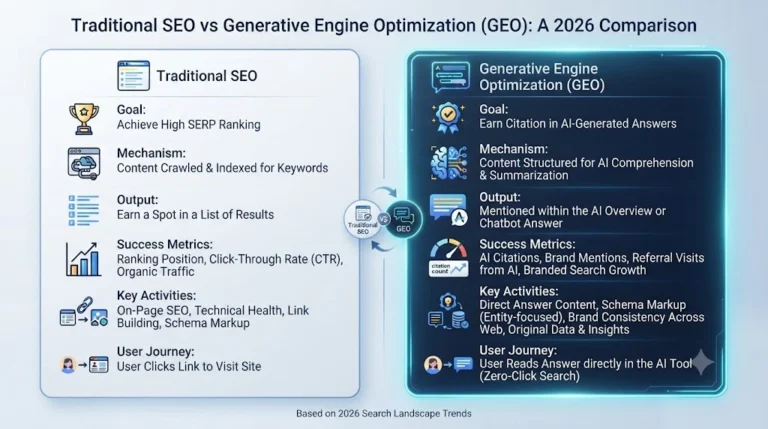
The goal. Traditional SEO tries to rank a page in the results. GEO tries to get your brand cited or mentioned inside AI-generated answers.
How success is measured. SEO looks at position, clicks and organic traffic. GEO looks at citations, brand mentions, referral visits from AI tools and growth in branded searches.
The content style. SEO pages are built around target keywords and search intent. GEO pages lead with a direct, extractable answer and name the entities involved (your business, services, locations) clearly.
The signals that matter. SEO leans on links, relevance and technical health. GEO adds clarity, consistency of your brand details across the web, authority and structured data.
These two aren’t rivals. GEO sits on top of SEO. AI systems mostly draw from pages that are already crawlable, fast and well regarded, so skipping the fundamentals leaves GEO with nothing to build on. The change is that ranking is no longer the finish line. A page can rank third and still lose the customer if the AI answer above it names a competitor.
Answer engine optimization (AEO) started with featured snippets and voice assistants: structure content so a machine can lift a clean answer out of it. GEO extends the same idea to generative tools that write their own answers. The two overlap heavily, so don’t spend energy arguing over the label. Write pages that answer the question in the first two sentences, then back it up with detail.
A good generative engine optimization service isn’t prompt-stuffing or a trick. The work is fairly concrete:
Be wary of anyone who guarantees a citation in ChatGPT or an AI Overview. Nobody controls those outputs. An honest AI search ranking service talks about improving your odds and measuring them.
Transactional and local searches (“near me”, “book”, “price”) still send plenty of direct clicks. Technical health, page speed, backlinks and solid on-page work still decide who gets crawled and trusted. AI Overviews also link out to the pages they draw from, so ranking well still feeds citation.
If that’s a lot on top of running a business, our AIO/GEO Optimization Services page shows how a generative engine optimization service like ours handles the audit, rewrites and tracking, and the homepage covers the wider picture.
It’s a service that improves your odds of being cited or recommended in AI-generated answers, such as Google AI Overviews, ChatGPT and Perplexity. It combines content restructuring, schema, brand consistency and citation tracking.
No. GEO builds on SEO. AI answers mostly draw from pages that already rank and are technically sound, so you need the base before the extra layer helps.
It’s a search where the user gets the answer on the results page or in an AI tool and never clicks through. It hits informational queries hardest, because the answer is short enough to summarise.
AEO focuses on being the answer in snippets and voice results. GEO focuses on being cited inside longer AI-written answers. The tactics overlap, so most teams run them as one workflow.
No. Those outputs are controlled by the platforms and change often. A reputable provider can improve your chances and measure your visibility, not promise a placement.
Compare impressions and clicks in Search Console for informational queries over the last few months. Flat impressions with falling clicks suggest answers are being resolved on the results page.
It helps machines understand your entities, such as your business, services and FAQs. It isn’t a ranking switch on its own, but it removes ambiguity that can keep you out of answers.
It depends on how many pages, queries and platforms are in scope and whether tracking is ongoing. A fair provider should quote after an audit, not before it.
There’s no fixed timeline. Content changes get re-crawled over weeks, and AI answers vary, so track trends over a few months instead of judging one search.
If customers research before buying, then yes, starting with your top pages and questions is reasonable. You don’t need a huge budget to begin, just a clear list of queries and a willingness to rewrite for direct answers.
Search isn’t dying, but it is splitting in two: a list of links you can rank in, and an answer you can be quoted in. Traditional SEO keeps you visible in the first, and GEO is how you show up in the second. Treat a generative engine optimization service as an extension of your SEO, not a replacement for it, and judge it by what it measures: citations, referral traffic and brand searches, not just positions.
If you’d like to know where your brand appears in AI answers today, and where competitors are being named instead, talk to us about a generative engine optimization service built around your queries. Call 9718159724 and we’ll go through it with you.