Voice Search and Local SEO: What “Near Me” Queries Actually Need
Voice Search and Local SEO: What “Near Me” Queries Actually Need Voice search local SEO is about making your business...
Read More → AI Overview Optimization (AIO) is the practice of structuring your content so Google’s AI-generated summaries can find it, understand it, and cite it as a source. An ai overview optimization service does this work for you. It audits your pages, rewrites them to give direct answers, and checks whether your brand actually appears when people search. If you’ve noticed that many searches now start with a written summary instead of ten blue links, this guide explains what changed and what you can do about it.
Google AI Overviews are short, AI-written answers that sit at the top of some search results. They pull information from several web pages and link to the sources underneath.
AIO is about being one of those sources. Ranking on page one used to be the whole goal. Now there’s a second question: when Google writes the answer itself, is your page one of the ones it draws from?
That changes what “good content” means. A page that buries its answer under 400 words of introduction may rank fine and still get skipped by an AI that’s looking for a clear, extractable statement.
Nobody outside Google knows the exact formula, and anyone who claims to is guessing. But Google’s own guidance and years of observation point to a few consistent patterns:
The AI often breaks a search into several related sub-questions and pulls from different pages for each one. That’s why covering the surrounding questions of a topic matters, not just the main keyword.
These terms overlap, and beginners often get lost in them.
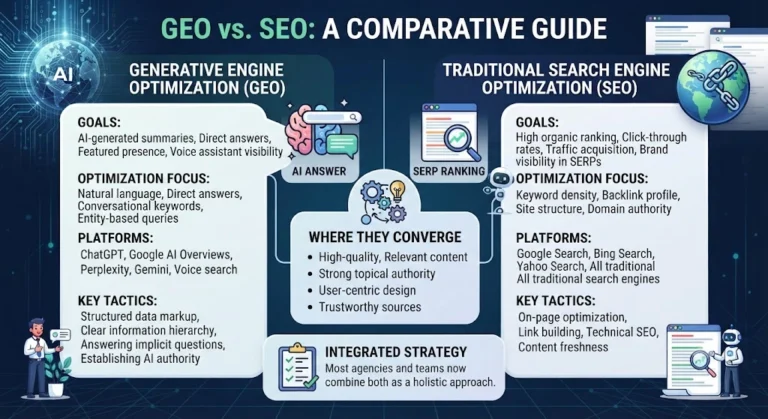
SEO is the foundation: making pages crawlable, relevant and authoritative so they rank in search results.
AIO applies specifically to Google’s AI Overviews.
Answer engine optimization (AEO) is broader. It covers any platform that gives direct answers, including featured snippets, voice assistants and AI chatbots.
GEO SEO (generative engine optimization) extends the idea to generative tools like ChatGPT, Perplexity and Gemini, where the AI writes an answer and may or may not cite a website.
In practice the work is largely shared. Clear structure, direct answers, strong topical coverage and trustworthy content help across all of them. That’s why most agencies now bundle these into a single generative engine optimization service instead of selling them separately.
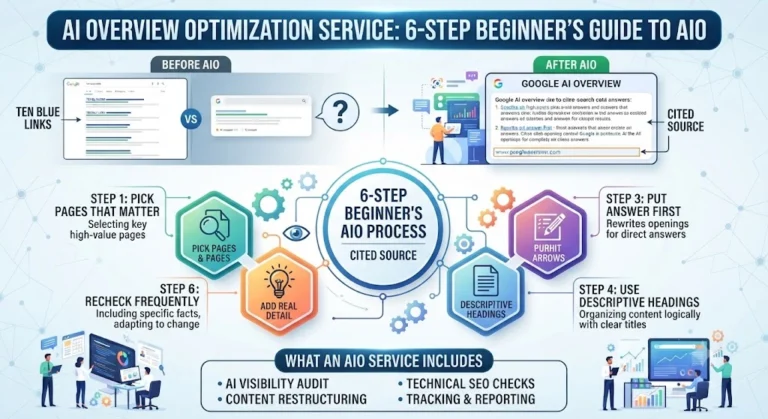
Scope varies between providers, so ask for specifics. A solid ai overview optimization service usually covers:
Be cautious of any provider promising guaranteed placement in AI Overviews. No one controls that, and honest providers will say so.
You can begin before hiring anyone. Here’s a practical first pass:
Step 1: Pick five pages that matter. Choose the pages tied most closely to leads or sales, not your whole site.
Step 2: Search your target queries. Note whether an AI Overview appears and which sources it cites. Read those pages to see what they do that yours doesn’t.
Step 3: Put the answer first. Rewrite the opening of each page so the main question is answered in the first two or three sentences.
Step 4: Use descriptive headings. A heading like “How Long Does the Process Take?” tells both readers and machines what follows. “Our Approach” tells them nothing.
Step 5: Add real detail. Steps, comparisons, examples, definitions and honest limitations make a page worth citing.
Step 6: Recheck in a few weeks. AI results shift, so treat this as ongoing work rather than a one-time fix.
For a small site with a handful of key pages, doing the basics yourself is realistic. Direct answers, clear headings and better coverage cost nothing but time.
A professional ai overview optimization service makes more sense when you have many pages, competitive queries, or no in-house SEO capacity. It also helps when you need proper measurement, because tracking AI citations across dozens of queries by hand gets tedious fast.
If you want to see how this fits into a broader search strategy, our AIO/GEO Optimization Services page explains how AI Overview work, GEO and traditional SEO are combined into one plan.
AIO stands for AI Overview Optimization. It means improving your content so Google’s AI-generated summaries can understand it and cite it as a source.
Yes, but they’re closely linked. SEO gets your pages crawled, indexed and ranked. AIO builds on that by making the content clear and specific enough for an AI to pull answers from it.
No. Google doesn’t sell placement in AI Overviews. Any ai overview optimization service can only improve the quality and clarity of your content, not buy you a spot.
It depends on how often Google recrawls your pages, how competitive the topic is and how much needs fixing. Expect weeks to months rather than days.
No special markup is required. Accurate structured data can help Google understand your content, but it isn’t a switch that turns on AI Overview visibility.
AIO focuses on Google’s AI Overviews. GEO, or generative engine optimization, covers AI tools more broadly, including ChatGPT, Perplexity and Gemini. Most geo seo work overlaps heavily with AIO.
Nearly. Answer engine optimization covers any platform that gives direct answers, from featured snippets and voice assistants to AI chatbots. AIO is one part of it.
Yes. Small businesses with specific expertise or a clear local focus can compete well, because AI answers reward specific, useful content rather than just big brand names.
Ask what exactly is included, how they measure AI citations, and what they do beyond rewriting content. Walk away from anyone who guarantees placement.
Search your target queries and check whether an AI Overview appears and lists your site. Repeat this regularly, since results change. Dedicated tracking tools can automate it at scale.
AI Overviews haven’t made SEO obsolete, but they’ve changed what a winning page looks like. Clear answers, specific detail, solid structure and a trustworthy source now matter as much as rankings. Whether you start with the DIY steps above or bring in an ai overview optimization service, begin with your most important pages and build from there.
Want to know where your site stands in AI search? Call us on 9718159724 and we’ll talk through your pages and your goals.