Voice Search and Local SEO: What “Near Me” Queries Actually Need
Voice Search and Local SEO: What “Near Me” Queries Actually Need Voice search local SEO is about making your business...
Read More → If your online store gets traffic but not enough sales, the problem usually isn’t your product — it’s how search engines and shoppers are experiencing your site before they even reach checkout. Thin product descriptions, duplicate listings across variants, a slow checkout page, and missing alt text on images are four of the most common ecommerce SEO mistakes quietly costing stores rankings and revenue every day. Fixing them is often less about writing more content and more about writing the right content, structured the right way.
Below is a practical breakdown of where most Indian ecommerce stores lose visibility, why it happens, and what actually fixes it — the same audit approach used when we work with clients through our ecommerce SEO services.
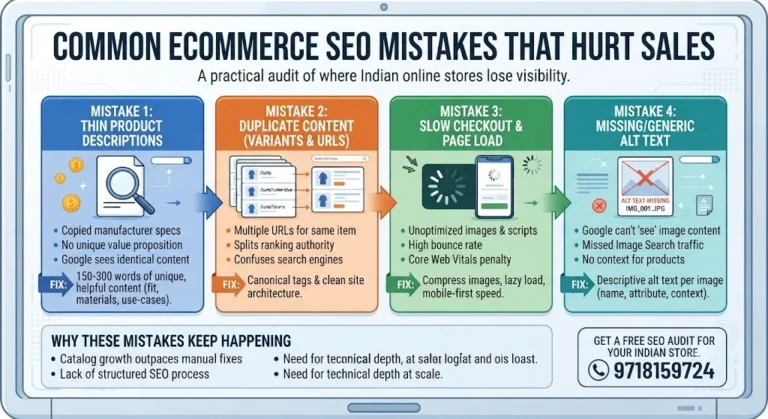
A one-line product description copied from the manufacturer’s spec sheet tells Google nothing unique about your page — and it tells the shopper even less about why they should buy from you instead of the next store selling the same item.
What it looks like: “100% cotton t-shirt, available in 5 colors, machine washable.” That’s a spec, not content. Google has no reason to rank this over a hundred identical listings.
Why it hurts: Search engines reward pages that answer real buyer questions — fit, fabric feel, care instructions, who it’s best suited for, how it compares to similar products. Without that, your page has nothing to rank on beyond the product name itself.
The fix: Write 150–300 words per product minimum, covering use cases, materials, sizing guidance, and the specific problem the product solves. Category pages need their own unique intro copy too — not just a grid of products.
This is one of the most damaging ecommerce SEO mistakes because it’s invisible unless you’re specifically looking for it. Size and color variants, filtered URLs, and products listed under multiple categories can all generate near-identical pages that compete with each other instead of your competitors.
What it looks like: /product/blue-kurta, /product/blue-kurta?size=m, and /category/kurtas/blue-kurta all showing the same content to Google as three separate URLs.
Why it hurts: Search engines can’t decide which version to rank, so often none of them rank well. You end up splitting your own authority across pages competing against each other.
The fix: Canonical tags on variant URLs, consistent category structuring, and a clean site architecture where every product has one authoritative URL. This is exactly the kind of technical cleanup that separates a store that ranks from one that doesn’t, no matter how good the copy is.
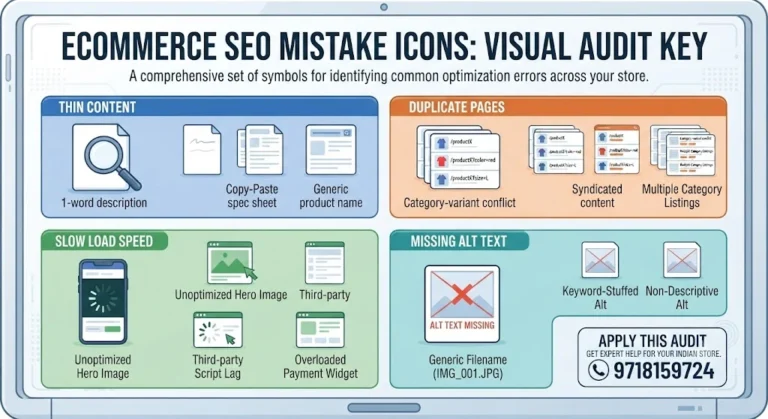
SEO doesn’t stop at rankings — it includes what happens after the click. A slow checkout page increases bounce rate, and Google’s Core Web Vitals directly factor page experience into rankings.
What it looks like: Checkout pages loaded with unoptimized images, third-party scripts, and payment widgets that take 4-5+ seconds to become interactive.
Why it hurts: Every additional second of load time on checkout correlates with drop-offs. Even if your SEO brings the right traffic in, a slow checkout undoes that work at the final step — and search engines notice the resulting behavioral signals too.
The fix: Compress and lazy-load images, minimize unnecessary scripts on the checkout flow specifically, and test mobile load speed separately from desktop — most Indian ecommerce traffic is mobile-first.
Alt text isn’t just an accessibility checkbox — it’s one of the few places Google reads image content directly, and it’s a real driver of Google Image search traffic for product-based stores.
What it looks like: Alt attributes left blank, or filled with “image1.jpg,” “product-photo,” or the same generic phrase repeated across an entire catalog.
Why it hurts: You lose a legitimate ranking signal and an entire traffic channel (image search) that’s especially strong for fashion, home decor, and visually-driven product categories.
The fix: Descriptive, specific alt text per image — product name, key attribute, and context (e.g., “women’s block-print cotton kurta in indigo blue, front view”) rather than keyword-stuffed repeats.
Most of these issues aren’t caused by one bad decision — they build up as a catalog grows. A store with 50 products can manage descriptions manually. A store with 5,000 SKUs across variants, categories, and filters usually can’t, without a structured process behind it. That’s the actual gap between stores that DIY their SEO and stores that bring in the best ecommerce SEO services in India to handle it properly — the difference isn’t effort, it’s process and technical depth at scale.
If you’re evaluating ecommerce SEO marketing services, ask specifically how they handle canonicalization on variant pages, whether they audit alt text catalog-wide (not just on hero images), and how they approach product content that won’t read as duplicate or thin. Those three questions alone will filter out most generic agencies.
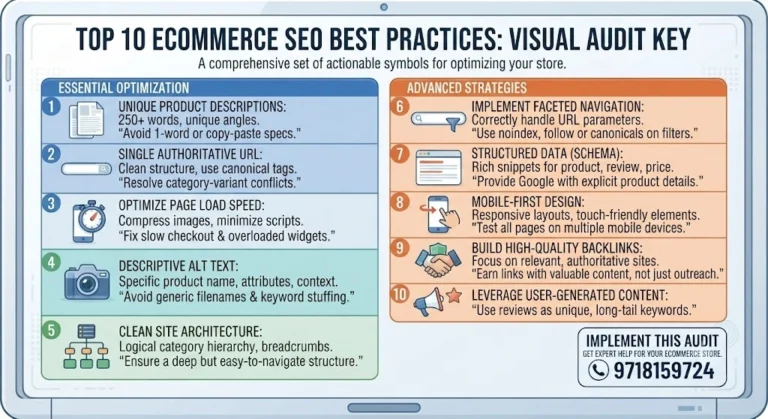
Thin or duplicate product content is the most widespread issue — it affects nearly every store with more than a few hundred SKUs, especially where descriptions are copied from suppliers.
It usually comes from URL parameters (size, color, sorting filters), products listed under multiple categories, or the same product syndicated across marketplaces and your own store without canonical tags.
Both. Page speed is a confirmed Google ranking factor through Core Web Vitals, and slow checkout pages also increase bounce and cart abandonment, which affects the behavioral signals search engines use to judge page quality.
There’s no fixed number, but under 50 words rarely gives Google or the shopper enough to work with. 150-300 words of genuinely useful detail (fit, use case, materials, comparisons) is a reasonable working range for most categories.
Yes, particularly for visually-driven categories like fashion, jewelry, and home decor, where Google Image search sends meaningful organic traffic that text-only optimization misses entirely.
Smaller catalogs can often be fixed manually. Once you’re managing thousands of SKUs across variants and categories, a structured, ongoing process — usually through dedicated ecommerce SEO marketing services — becomes far more practical than manual fixes.
Check Google Search Console for pages marked “duplicate, Google chose different canonical” or “crawled, not indexed” — these are strong indicators of duplicate content issues on your site.
Ask how they handle canonicalization, catalog-wide alt text audits, and content depth on product pages specifically — not just general keyword and backlink work, which doesn’t address these structural issues.
No single fix guarantees rankings, but these four issues are foundational — leaving them unresolved actively caps how well any other SEO work (content, backlinks, technical fixes) can perform.
Technical fixes like canonical tags and speed improvements can show crawl and indexing changes within a few weeks; content and ranking improvements typically take 2-4 months to reflect fully, depending on competition and how deep the original issues were.
Ecommerce SEO mistakes rarely show up as one obvious red flag — they show up as declining organic traffic, high bounce rates, and sales that don’t match your ad spend. Thin content, duplicate pages, slow checkout, and missing alt text are individually fixable, but they usually need to be fixed together as part of one audit, because they tend to compound each other on larger catalogs. If you’d rather have this diagnosed and fixed properly than DIY it across thousands of SKUs, that’s exactly what a proper ecommerce SEO audit and ongoing strategy is built for.
Want your store audited for these exact issues? Call 9718159724 for a straightforward walkthrough of what’s currently holding your rankings back — no generic pitch, just a look at your actual site.