Voice Search and Local SEO: What “Near Me” Queries Actually Need
Voice Search and Local SEO: What “Near Me” Queries Actually Need Voice search local SEO is about making your business...
Read More → If your business isn’t showing up in the map pack or local search results anymore, the cause is usually not some mysterious algorithm shift — it’s a handful of fixable errors sitting quietly in your Google Business Profile and citations. A local SEO service provider spends most early audit hours finding the same four culprits: duplicate listings, inconsistent NAP, missing reviews, and the wrong business category. Fix those, and rankings often recover faster than most business owners expect.
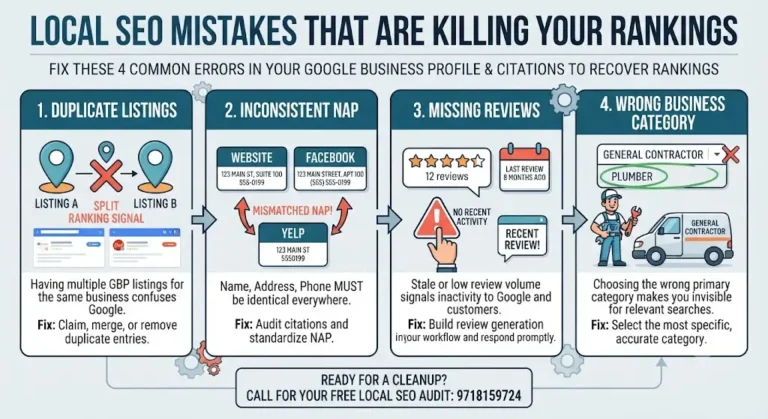
When a business has two or more Google Business Profile listings — often created by accident during a rebrand, a change of address, or a well-meaning employee setting up a “new” profile — Google doesn’t know which one to trust. Instead of one strong listing with consolidated reviews and history, you end up with two weak ones competing against each other, and sometimes against your own real listing.
This happens more often than people realize. A plumbing company moves three blocks down the street, sets up a new listing “just to be safe,” and forgets to close the old one. Six months later, reviews are split between two profiles, and neither ranks where it should.
The fix: search your business name plus city on Google Maps and check for near-identical entries. Claim the duplicate, request its removal through Google, and redirect any traffic or citations pointing to it toward your primary listing.
NAP — Name, Address, Phone number — needs to match exactly across your website, Google Business Profile, Facebook, Yelp, industry directories, and anywhere else your business is listed. “Street” on one platform and “St.” on another might look harmless to a human, but it’s the kind of inconsistency that makes Google’s local algorithm less confident about which business entity it’s actually dealing with.
Suite numbers left off in some places, an old phone number still floating around on a directory you forgot existed, a slightly different spelling of your business name — each one chips away at the trust signal that citations are supposed to build.
The fix: run a citation audit across the directories your business actually appears on, standardize the exact NAP format you’ll use everywhere, and update the outliers one by one. This is usually the single highest-leverage task in a local seo audit, because it touches every ranking signal downstream of it.
A thin review count, or a page that hasn’t had a new review in eight months, tells Google — and every potential customer — that this business might not be very active. Review volume, recency, and how the owner responds all factor into local ranking, not just star rating.
The businesses that consistently show up at the top usually aren’t the ones with the most flawless five-star average. They’re the ones with a steady, ongoing trickle of recent reviews and thoughtful responses to both the good ones and the occasional bad one.
The fix: build reviews into your actual workflow — a text or email sent right after a job is completed, while the experience is still fresh, rather than a generic ask months later. Respond to every review, even short ones. A stalled review profile is one of the easiest things to reverse once you have a system in place.
This is the mistake even experienced business owners overlook. Google Business Profile lets you pick a primary category and several secondary ones, and picking the wrong primary category — or a category that’s too broad — means you simply won’t show up for the specific searches your customers are actually typing.
A “General Contractor” who does mostly bathroom remodels but never selects “Bathroom Remodeler” as a category is invisible for exactly the searches that would bring in the most qualified leads. The category field isn’t decoration; it’s one of the strongest ranking signals Google has for matching a search to a business.
The fix: research the exact categories your competitors who already rank well are using, choose the most specific accurate primary category available, and add relevant secondary categories without stuffing in ones that don’t genuinely apply.
None of these problems exist in isolation. A duplicate listing splits your reviews. Inconsistent NAP makes Google less sure which of your (possibly duplicate) listings is the real one. A wrong category means even a clean, well-reviewed profile shows up for the wrong searches. That’s why a proper local seo audit checks all four together rather than fixing one and hoping the rest sorts itself out — and why hyper local seo services built around neighborhood-level targeting only work once the foundational profile is clean.
If you’re building out a broader strategy for your service area, our Local SEO Services page covers the full process end to end, from citation cleanup through ongoing ranking maintenance.
Search your exact business name along with your city on Google Maps. If two pins show up for the same or a very similar address, you likely have a duplicate that needs to be merged or removed.
It won’t happen overnight, but consistent NAP across directories is one of the trust signals Google uses to confirm your business is legitimate and stable, which supports steadier rankings over time.
There’s no fixed number — what matters more is recency and consistency. A business with 40 reviews trickling in steadily usually outperforms one with 200 reviews that stopped a year ago.
Yes, and if your current category is wrong, changing it usually helps rather than hurts. Just make sure the new category is genuinely more accurate, not just more popular.
Your primary category should describe the main thing your business does and carries the most ranking weight. Secondary categories cover additional services and help you show up for a wider range of related searches.
At minimum once a year, or immediately after any change to your business name, address, or phone number.
Yes — an active response pattern signals engagement to Google, and it also reassures future customers reading through your review history.
It’s an approach that targets neighborhood- or suburb-level searches rather than just the whole city, which matters most for businesses that serve a specific radius rather than an entire metro area.
Yes — third-party directories and data aggregators sometimes auto-generate listings from old business data, which is why periodic audits catch things you never manually created.
Most businesses start noticing movement within 4-8 weeks, though it depends on how competitive the local market is and how long the errors had been in place.
These four mistakes are the most common reasons local rankings stall, but they’re also some of the fastest to fix once someone actually looks. If you want a clear picture of where your listings currently stand, call 9718159724 for a straightforward local SEO audit — no jargon, just what’s broken and what it’ll take to fix it.