Voice Search and Local SEO: What “Near Me” Queries Actually Need
Voice Search and Local SEO: What “Near Me” Queries Actually Need Voice search local SEO is about making your business...
Read More → If you run a local business and you’re not showing up in the top three results Google displays with the map — the ” Google Map Pack” — you’re losing customers to competitors who are. A good google local seo service doesn’t chase shortcuts; it works on the same three levers Google itself uses to decide who gets that spot: proximity, relevance, and prominence.
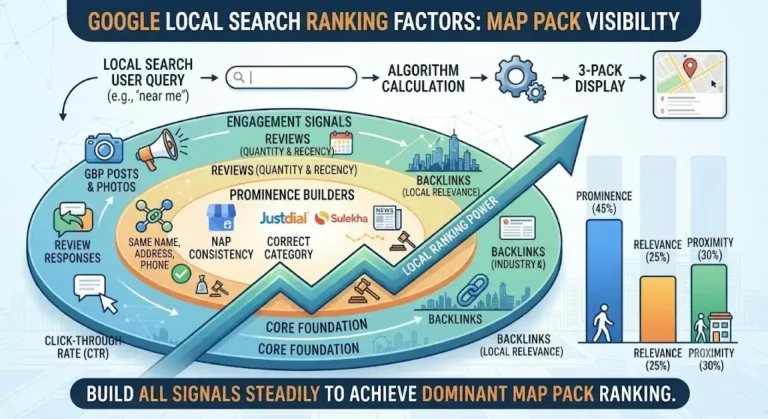
When someone searches for something like “plumber near me” or “dentist in [city],” Google shows a map with three business listings above the regular organic results. That’s the Map Pack, sometimes called the Local 3-Pack. It’s tied directly to your Google Business Profile (GBP), not your website’s regular SEO ranking — although the two influence each other more than most business owners realize.
Getting into that 3-pack matters because most people never scroll past it. They call, they get directions, they walk in. If your business isn’t there, you’re invisible to a huge chunk of “ready to buy” local searches.
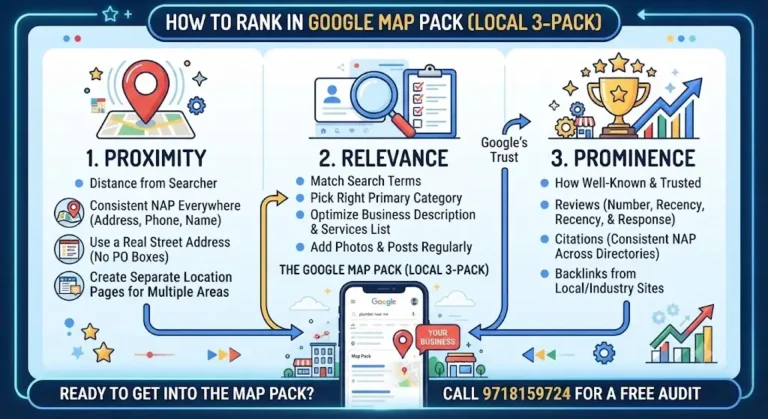
Google has been fairly open about the three inputs it weighs for local results. Any serious google map local seo services effort has to work on all three at once — focusing on just one usually stalls out.
This is the distance between the searcher (or the location they typed) and your business address. It’s the one factor you genuinely cannot change — you can’t move your shop closer to every searcher. What you can do is make sure Google has zero doubt about where you actually are:
Relevance is how well your listing and website match what the searcher typed. This is where most map pack ranking work actually happens, because it’s the part you have the most direct control over.
Prominence is Google’s read on how well-known and trusted your business is, both online and off. It’s built slowly, through consistent signals:
There’s no way to fake prominence overnight. Businesses that treat it as a checklist to rush through usually see rankings that spike and then fade — the ones that hold their position are the ones building these signals steadily, month after month.
Rather than trying to do everything at once, most local businesses see the clearest progress working roughly in this order:
This work connects directly to your broader local visibility strategy — if you haven’t already, it’s worth reviewing your Local SEO Services approach as a whole, since Map Pack rankings and general local search visibility reinforce each other rather than operating separately.
There’s no fixed timeline — it depends on your competition, how established your GBP already is, and how consistently you work on citations and reviews. Most businesses see measurable movement over a few months of steady work, not days.
Yes, indirectly. A well-optimized, relevant website supports the relevance signal Google uses for local rankings, even though the Map Pack itself is primarily driven by your Business Profile.
Yes, if you’re a legitimate service-area business, you can set up your GBP accordingly and hide your exact address while still targeting the areas you serve.
There’s no magic number. What matters more is a steady, ongoing flow of recent reviews rather than a one-time burst followed by silence.
It contributes to prominence and shows engagement, and it also directly affects whether potential customers trust and choose your business.
Local SEO is the broader strategy — website content, citations, links, and technical setup. Map Pack optimization is a specific subset of that work focused on your Google Business Profile and the three ranking factors above.
Google does show a separate “Local Services Ads” or sponsored placement in some searches, but the organic Map Pack itself is not something you can pay directly to appear in — it’s earned through the ranking factors covered here.
Generally no, unless they’re genuinely separate legal businesses at separate addresses. Multiple profiles for the same business usually violates Google’s guidelines and can hurt rather than help.
Common causes include a recent Google algorithm update, a competitor improving their signals, a duplicate or suspended listing, or inconsistent NAP information somewhere online. Checking your GBP dashboard for any policy notices is a good first step.
Yes. Google recalculates the 3-pack for each individual search based on the searcher’s exact location and the specific terms used, so your ranking can genuinely vary from one nearby street to another.
If your business isn’t showing up where your customers are searching, the fix is usually a mix of profile cleanup, consistent citation work, and a steady review process — not one single trick. Call 9718159724 to talk through where your listing currently stands and what it would take to get you into the top three.