Voice Search and Local SEO: What “Near Me” Queries Actually Need
Voice Search and Local SEO: What “Near Me” Queries Actually Need Voice search local SEO is about making your business...
Read More → Off-page SEO in 2026 isn’t about mass-submitting your URL to random directories anymore — that game died years ago. What actually moves rankings today is a mix of earned authority, real digital relationships, and signals Google’s algorithms can’t fake or ignore. If you’re evaluating off page seo services in india, the agencies worth paying for are the ones still doing the five things below, not the ones selling you a spreadsheet of 500 “high DA” backlinks.
Here’s what’s genuinely working right now, and why the shortcuts have stopped paying off.
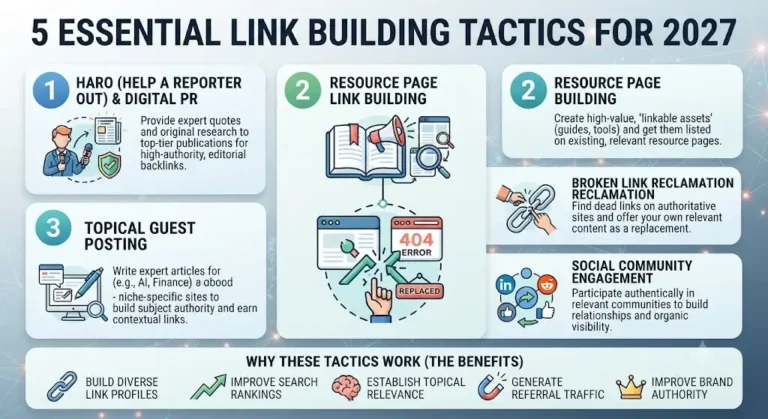
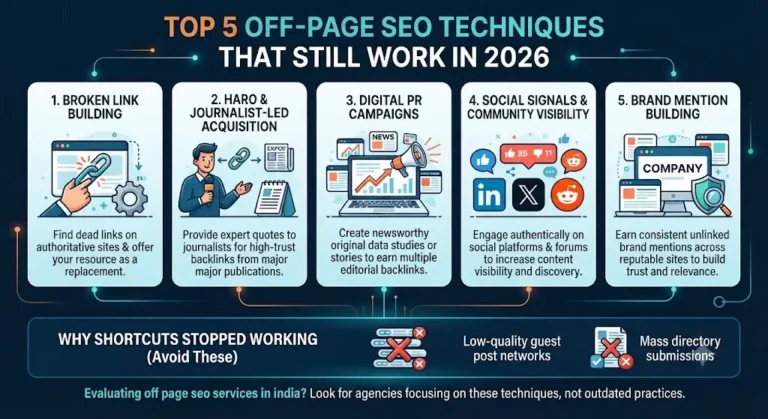
Broken link building has survived every algorithm update because it solves a real problem instead of gaming one. The process is simple on paper: find a dead link on a relevant, authoritative page, create (or point to) a resource that replaces it, and let the site owner know their page has a gap you can fill.
What’s changed by 2026 is the scale at which this can be done. Tools can now crawl entire competitor backlink profiles and flag broken pages in bulk, which means the bottleneck isn’t finding opportunities anymore — it’s outreach quality. A generic “hey, found a broken link, please replace it with mine” email gets ignored. What works is referencing the specific page, explaining exactly why your resource fits better, and keeping the ask short. Agencies offering seo backlink building services that still rely on this method tend to get links that stick, because the webmaster genuinely benefits from fixing their page.
HARO (Help a Reporter Out) and its newer alternatives connect journalists looking for expert quotes with businesses willing to provide them. In exchange for a genuinely useful quote, you often get a mention and a backlink from a publication Google already trusts.
The catch: response speed and specificity matter more than ever. Journalists get flooded with generic PR pitches, so a response with a real data point, a named expert, or a contrarian take gets picked far more often than “Our CEO says X is important.” This tactic sits at the intersection of PR and SEO, which is exactly why it’s grouped under digital pr for seo — you’re not asking for a link directly, you’re earning one by being a useful source.
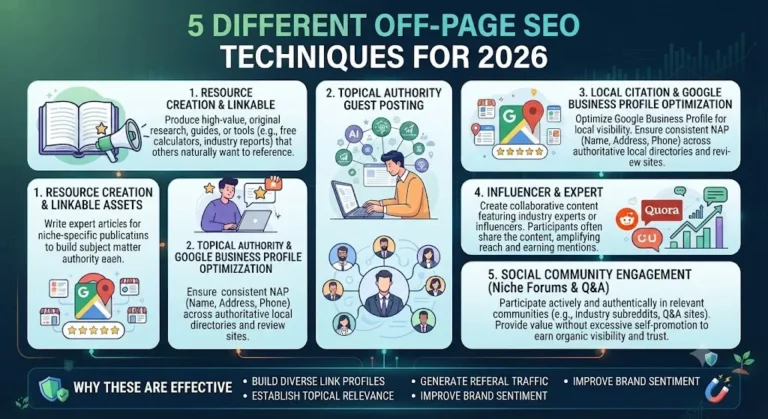
Digital PR has quietly become the backbone of serious off-page strategy. Instead of chasing individual backlinks one email at a time, you create something newsworthy — an original survey, a data study, a controversial industry take, a well-timed reaction to news — and pitch it to journalists and niche publications at once.
Done well, one successful digital PR campaign can generate dozens of contextual, editorial backlinks in a single wave, along with brand mentions on sites you’d never get through cold outreach alone. The reason this still works in 2026 is that it produces exactly what search engines want to see: real coverage from real publications, not manufactured link placements. It’s also the technique most likely to produce links from sites with actual traffic, which matters for referral value, not just rankings.
Social signals — shares, engagement, mentions across platforms — aren’t a direct ranking factor the way backlinks are, but their indirect effect has grown, not shrunk. Content that gets discussed, shared, and debated on platforms like LinkedIn, X, and niche forums (Reddit communities, industry Slack/Discord groups) tends to get discovered and linked to organically by writers and researchers scanning those spaces for sources.
In 2026, this also intersects with how generative AI tools and answer engines surface sources — content with consistent social traction and cross-platform mentions is more likely to be cited as a reference point. The practical takeaway: don’t treat social distribution as an afterthought to publishing. Seed your content deliberately in the communities where your actual audience spends time, and respond to the conversation it generates instead of just dropping a link and leaving.
Unlinked brand mentions have become a legitimate off-page asset on their own. When your brand name shows up repeatedly across reputable sites, forums, review platforms, and industry publications — even without a hyperlink back to you — search engines increasingly treat this as a trust and relevance signal, especially combined with actual backlinks pointing to the same brand.
This is why serious link building isn’t just about the links anymore; it’s about consistent, recognizable presence. Getting quoted in an article, listed in an industry roundup, or discussed in a comparison piece all count, even link-free. Many agencies now actively track and pursue mentions the same way they track backlinks, then follow up separately to ask for the mention to be turned into a link where it makes sense.
Every technique above shares one trait: it requires actual effort tied to something real — a broken page genuinely fixed, a quote genuinely useful to a journalist, a story genuinely worth covering, a community genuinely engaged, a brand genuinely worth mentioning. That’s precisely why mass link schemes, PBNs, and low-quality guest post networks keep losing ground — they manufacture the appearance of authority without the substance behind it, and modern algorithms are built specifically to spot that gap.
If you’re comparing off page seo services in india, ask providers directly which of these five methods they actually run campaigns for, and ask to see real examples. That single question filters out a lot of agencies fast.
This ties directly into a broader strategy — for the full framework covering on-page alignment, technical prerequisites, and long-term link equity building, see our Off-Page SEO & Link Building Services page.
Off-page SEO covers everything that builds your site’s authority and reputation outside your own domain — backlinks, brand mentions, PR, and social signals. On-page SEO, by contrast, is about optimizing content, structure, and technical elements directly on your website.
Yes. It remains one of the more reliable tactics because it offers real value to the site owner — you’re helping them fix a dead link — rather than just asking for a favor.
HARO connects you with journalists actively looking for expert input for a story they’re already writing, whereas guest posting involves pitching and writing an entire piece yourself. HARO links tend to carry more editorial weight because they’re chosen by the journalist, not purchased or negotiated.
Not directly as a ranking factor, but social signals increase content visibility, which leads to more organic discovery, mentions, and backlinks from people who find your content through those platforms.
Digital PR means creating newsworthy content — original research, data studies, or timely commentary — and pitching it to journalists and publications to earn organic media coverage and backlinks, rather than acquiring links through direct outreach alone.
Yes, to a meaningful degree. Search engines can associate a brand name with a topic or industry even without a hyperlink, and consistent mentions across credible sites reinforce topical authority and trust.
There’s no fixed number — relevance and authority of the linking site matter far more than volume. A handful of contextual links from trusted, topically relevant sources outperforms hundreds of low-quality links.
Most off-page campaigns take a few months to show measurable ranking movement, since search engines need time to crawl, index, and factor in new links and mentions. Digital PR and HARO links can show impact faster because of the traffic and mentions they trigger immediately.
Purchased links that don’t follow search engine guidelines carry real penalty risk. Earned links — through PR, outreach, or genuine value — remain the safer and more durable approach.
Look for a provider who can explain their exact process for each technique (broken link building, HARO, digital PR, etc.), show real case examples, and avoid vague promises like “we’ll get you 100 backlinks a month” without context on link quality.
If you want an off-page SEO strategy built on the techniques that actually hold up — not recycled link packages — get in touch at 9718159724 and we’ll walk you through a plan specific to your site and industry.