Voice Search and Local SEO: What “Near Me” Queries Actually Need
Voice Search and Local SEO: What “Near Me” Queries Actually Need Voice search local SEO is about making your business...
Read More → Review response local SEO is the practice of replying to Google reviews so that customers trust you more and search engines get clearer context about your business. Google’s own guidance says that replying to reviews shows you value your customers and can support your local visibility. So it is more than a customer-service task. Google has not confirmed that response rate works as a direct ranking switch, and that difference decides where you should spend your time.
This guide covers how replies connect to rankings, what to write, what to avoid, and how to build a routine your team can actually keep.
Google decides local pack positions mainly on three things: relevance, distance, and prominence. Reviews feed prominence and relevance. The number of reviews, how often new ones arrive, the average rating, and the words customers use all shape how Google understands your business.
You can’t control what customers write. You can control what happens next, and that is where review response local SEO comes in. Your reply sits right under the review on your Business Profile. It is the one piece of text on that page that you fully control.
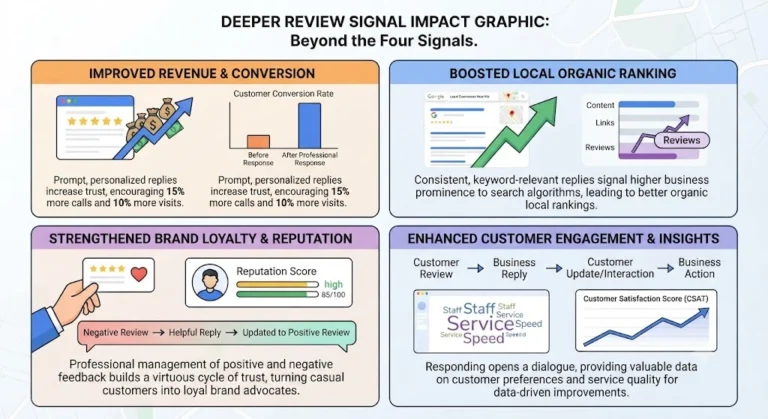
The honest answer is that it works mostly indirectly. Treat review response local SEO as a supporting signal and not a shortcut.
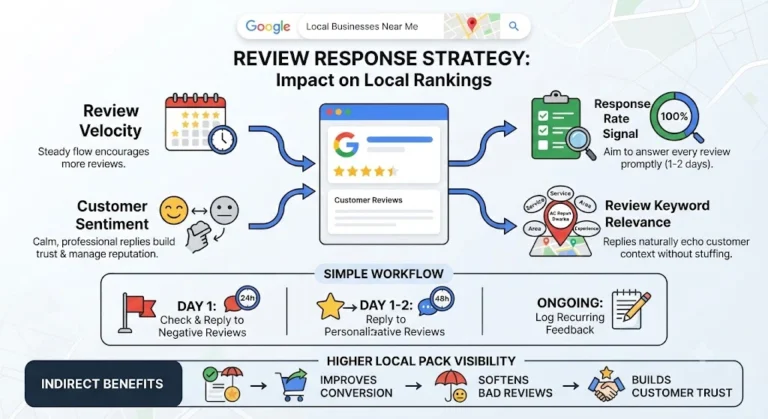
Review velocity is how steadily new reviews come in. Ten reviews in a single week followed by months of silence looks less healthy than a few reviews every week. Replying promptly keeps your profile active and shows new customers that feedback gets a response. Over time it makes asking for reviews easier.
The response rate signal is simply the share of your reviews that get an answer. Google doesn’t publish a threshold, but a profile where nearly every review has a reply looks cared for. A profile with dozens of unanswered reviews, especially unanswered complaints, looks neglected. Aim to answer every review, ideally within one or two working days.
Sentiment is the overall tone of what customers say about you. You can’t delete honest criticism, but you can show how you handle it. Prospects reading a negative review often read your reply before they decide anything. A professional, specific, non-defensive answer can change how that review looks.
Customers often mention the service, the product, or the neighbourhood in their reviews. Your reply can echo those details naturally. For example, “Thank you, Rohit. We’re glad the AC servicing in Dwarka went smoothly” reads like a human wrote it and carries useful context. Compare that with “Best AC repair Delhi cheap AC service Delhi,” which reads like spam and can look manipulative. Use the service name once, in a sentence a real person would say.
A workflow matters because inconsistent replying is the most common failure. Keep it short enough that people actually follow it.
Don’t copy-paste the same “Thanks for your feedback!” under every review. Repeated identical replies look automated, and they waste the chance to add context. A good reply is short and specific:
“Thanks, Priya. Good to hear the team finished your kitchen cabinet repair on schedule. We’ll pass your kind words on to them. See you next time.”
Notice what it does. It uses a name, refers to the actual job, and sounds like a person.
This is where review response local SEO has the most impact, because every future customer who sees the complaint will also see how you responded.
Replying works best alongside other steps: asking happy customers for reviews at the right moment, keeping your business information accurate, and tracking sentiment over time. This post is part of our wider local SEO pillar guide, which explains how reviews, citations, and Business Profile optimisation work together. If you manage several branches, replies need to be handled per location, with the right person answering for the right branch. That is covered in our next blog on multi-location SEO.
Review response local SEO means replying to customer reviews, mainly on Google Business Profile, in a way that builds trust and supports your local search visibility.
Google says replying to reviews shows customers you value them and can help your visibility. It has not confirmed response rate as a direct ranking factor, so treat it as a supporting signal that improves trust and engagement.
Aim for 24 hours on negative reviews and 48 hours on positive ones. Faster is better, but consistency matters more than perfect speed.
Yes, wherever possible. Replying to all reviews, including short star-only ratings, keeps your response rate signal strong and shows that you pay attention.
Only when it sounds natural. Mentioning the service the customer actually received is fine. Repeating keywords and city names in every reply looks spammy and can hurt trust.
Report it through your Business Profile if it breaks Google’s policies, and post a short, polite public reply stating that you can’t find a record of the visit and inviting them to contact you.
There is no fixed timeline. Trust and conversion improvements can appear within weeks, while changes in rankings depend on competition, review velocity, and your wider local SEO work.
The principles are the same, but each branch needs its own timely, location-specific replies from someone who knows that branch. A shared template across all locations looks careless.
Yes, especially negative ones that are still visible. A late reply is better than none, and it shows new visitors that the issue was taken seriously.
You can politely let them know the issue has been resolved and that they are welcome to update their feedback if they choose. Never pressure them or offer incentives for changing a rating.
Replying to reviews won’t magically push a weak profile to the top of the map pack, but it strengthens the things that do matter: trust, steady review activity, clear sentiment, and relevant context around your services. Done consistently, review response local SEO turns your Business Profile from a passive listing into an active, credible source of customer proof. Start small. Reply to every new review this week, personalise each answer, and keep your negative-review replies calm and specific. The habit will do more for you than any single tactic.
Want help building a review response process for your business? Call 9718159724 and talk to our team.