Voice Search and Local SEO: What “Near Me” Queries Actually Need
Voice Search and Local SEO: What “Near Me” Queries Actually Need Voice search local SEO is about making your business...
Read More → Link building AI search citations is a different job from traditional link building, because the goal is no longer just a higher ranking. The goal is to become a source that Google AI Overviews, ChatGPT and Perplexity trust enough to mention in their answers. Traditional link building asks, “How do I pass authority to this page?” Link building AI search citations asks, “Why would a machine pick this page as proof?” That one shift changes which links you chase, what content you build and how you measure success.
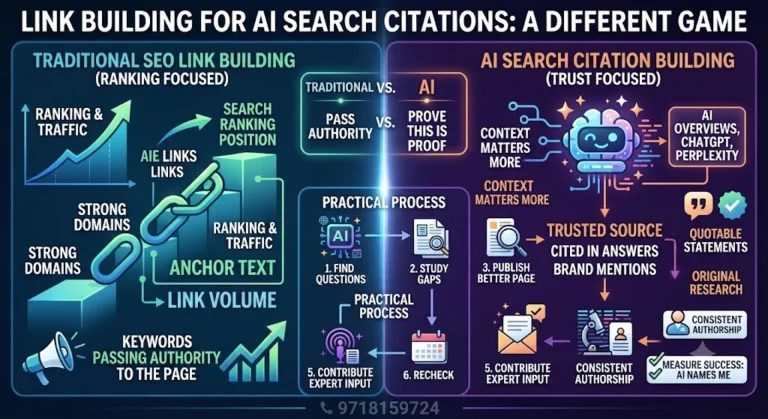
In classic SEO, a backlink works like a vote. More votes from stronger sites push a page higher in the results. AI search works differently. The engine reads several sources, summarises them and decides which ones to name. A page can rank on the first page and still never get cited. A lower-ranking page can get quoted because it states the answer clearly and is backed by credible mentions elsewhere. Link building AI search citations is the practice of earning the links and mentions that make your content look like the safest source to quote.
Traditional link building is mostly about the page. You collect links from strong domains, pay attention to anchor text and track success through rankings and traffic. Building links for AI citations is about the page and the brand behind it. Context matters more than quantity, so a mention inside a helpful, relevant paragraph carries more weight than a pile of unrelated links. The content itself also changes. Instead of pages built around a keyword, you need direct, quotable and verifiable answers that an engine can lift safely. Success is measured differently too, since you also check whether AI answers on your topic actually name you.
Nobody outside these platforms knows the exact formula, so treat the points below as practical citation signals to guide your link building AI search citations work, not as guaranteed rules.
Source credibility for AI search is built outside your website as much as on it. Engines look at how the rest of the web treats you. A mention from an industry publication, a university page, a professional association, a respected newsletter or a well-moderated community thread tells the engine that real people in your field consider you relevant.
This changes how you judge a link opportunity. Domain authority alone is a weak filter. Ask three questions instead. Is the linking page genuinely about my topic? Would a human reader trust this site? Does the link sit inside a sentence that explains why my page is useful? A mention inside a helpful paragraph is worth far more than a link buried in a footer or a bulk directory.
Every link building AI search citations plan starts with something worth citing. Nobody links to, or quotes, a page that repeats what everyone else already says. Citation-worthy content links come from pages that give people a reason to reference them.
Formats that tend to earn references naturally:
Put the main answer in one or two plain sentences near the top of each section, then support it with detail. This makes it easy for an editor or an AI engine to pull the line without distorting it.
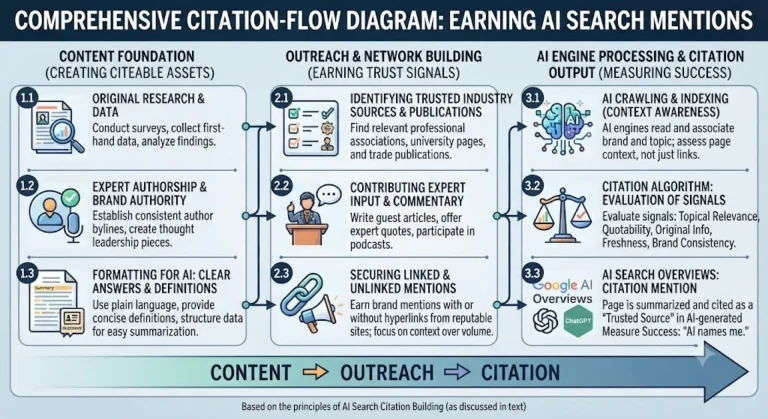
Authoritative linking works in both directions. When your page links out to primary sources, official documentation and recognised research, you show engines and readers where your claims come from. Avoid linking to weak sources just to add numbers. Keep anchor text descriptive, so the link tells the reader what they will find. Pages that cite good sources and get cited in return build a trust pattern that is hard to fake.
Links for AI overviews come from being useful, not from volume. Here is a simple process for link building AI search citations that you can repeat every month:
GEO link building, short for generative engine optimisation link building, treats links and brand mentions as one combined signal. A linked mention helps. An unlinked mention on a trusted site can also help engines associate your brand with a topic. So do not ignore press mentions, podcast appearances, community answers or inclusion in industry roundups just because the link is nofollow or missing.
Start small. Pick one topic you want to be known for, build one outstanding page on it and earn a handful of relevant mentions before widening your focus. Depth in one subject beats thin coverage of ten.
Link building AI search citations means earning links and mentions that make AI tools more likely to cite your page as a source in their answers.
Yes, but relevance, context and trust matter more than raw numbers. Backlinks remain one way engines learn which sources the wider web respects, though the exact weight of each signal is not public.
It can happen, usually when a page answers a specific question very clearly. Strong rankings still improve your chances, so treat rankings and citations as two goals, not rivals.
Not necessarily. A nofollow link from a trusted page can still bring referral visitors, visibility and brand association, so do not dismiss it.
Regular link building focuses mainly on passing authority to rank a page. GEO link building also values brand mentions, context and consistent entity information, because generative engines read and summarise the web instead of just ranking it.
Original research, precise definitions, honest comparisons and practical templates usually attract references faster than general opinion posts.
There is no fixed timeline. Outreach and relationship building take weeks to months, and AI answers change often, so track progress monthly instead of expecting overnight change.
Ask the questions your audience would ask in Google AI Overviews, ChatGPT and Perplexity, note which sources are named and repeat the check monthly. A simple spreadsheet is enough.
Authoritative linking to reliable sources shows where your claims come from and helps readers trust the page. Use descriptive anchor text and link only to sources you would genuinely recommend.
Yes. Link building AI search citations can work well for small, focused sites, because clear expertise in one narrow topic can matter more than overall size.
Link building AI search citations is less about volume and more about trust. Earn links from relevant, credible pages, publish content that is easy to quote, keep your authorship and brand details consistent and check regularly whether AI tools are naming you. Traditional SEO signals still matter, but the sites that get cited are the ones that give engines a clear, reliable reason to pick them. Start with one topic, build one strong page and grow from there.
For guidance on your SEO and content strategy, call 9718159724.