Voice Search and Local SEO: What “Near Me” Queries Actually Need
Voice Search and Local SEO: What “Near Me” Queries Actually Need Voice search local SEO is about making your business...
Read More → The content depth vs length SEO question has a short answer: depth helps you rank, length alone doesn’t. Google doesn’t count your words. It checks whether your page fully solves what the searcher came for. A 700-word page that covers every angle of a narrow question can beat a 3,000-word page that keeps circling the point. Length is usually a side effect of depth, not the reason for it.
This guide sits inside our On-Page SEO , and it explains how to judge your own pages so you stop chasing word counts and start closing real gaps.
Look at the first page of Google for almost any competitive query and you’ll notice long articles. That observation is real. The conclusion people draw from it is backwards, though. Complex topics need more words to be answered properly, so strong pages tend to run long. Stretching a thin page to 2,000 words copies the size of those pages and none of the substance.
Word count is also easy to see and easy to report, which is why it became the default target in content briefs. Depth is harder to measure, so people skip it. That gap is where the content depth vs length SEO confusion lives.
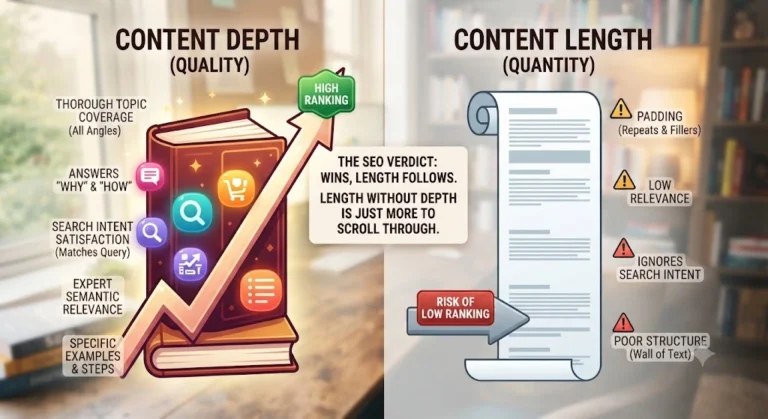
Depth is about how completely a page handles a topic and the questions around it. It isn’t about how many paragraphs you wrote. A deep page usually shows these traits:
Before you add or cut a single paragraph, run the page through a few plain checks:
Doing this once per page, with the top results open in another tab, teaches you more about content depth vs length SEO than any word-count rule will.
Length isn’t the enemy, and cutting a page short just to look lean is the same mistake in reverse. It leaves real questions unanswered. Some topics simply can’t be handled in 600 words: a full technical audit process, a comparison of several tools, or a beginner guide that starts from zero. In those cases the extra length is doing real work, because each section answers a separate need.
Shorter pages win when the query is narrow. Someone searching for a definition or a quick fix doesn’t want to scroll through background. The best content depth vs length SEO decision is to let the query decide the size, not a template.
Most of the damage in content depth vs length SEO comes from a handful of habits that are easy to spot once you know them.
Start with your existing page and work through it in this order:
After this edit, your page may end up longer or shorter. Either result is fine, because you’ve improved coverage rather than chased a number. It also fits neatly with matching the page to what people are actually looking for
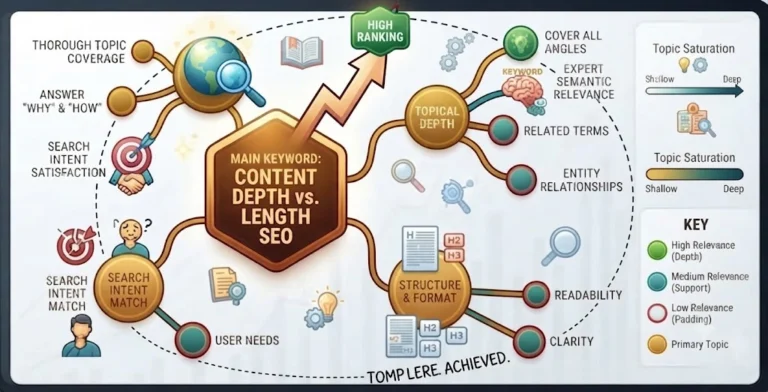
A page can be long, detailed and still miss. If someone wants a quick comparison and you deliver a history lesson, the depth is pointed in the wrong direction. That’s why content depth vs length SEO is never a standalone decision. Depth only counts when it serves the intent behind the query. Figure out the intent first, then decide how much ground the page has to cover.
Not automatically. Longer pages rank often because complex topics need room, but Google rewards pages that satisfy the query, whatever their size.
There’s no fixed number. Check the top results for your keyword, see what they cover, and write as much as your topic needs. A quick answer might take 500 words and a full guide 2,500.
It means how thoroughly a page covers a topic, including the related questions and subtopics a reader is likely to have, with specific examples instead of surface-level statements.
Yes. When the query is narrow and the short page answers it directly and completely, it can rank above longer, unfocused pages.
Google has never confirmed a minimum word count as a ranking factor. Pages are judged on usefulness and relevance to the search.
Compare it with the top-ranking pages. If they cover subtopics or answer questions yours doesn’t, you have gaps. Your page should also let a reader finish the task without searching again.
Intent decides what kind of depth is needed. A how-to query needs steps, a comparison query needs side-by-side points, and a definition query needs a clear, short explanation first.
They’re related terms and concepts that tend to appear in thorough coverage of a topic. Use them to guide what you cover, but don’t insert them just to have them in the text.
Only if the words add missing information. Adding filler can make a page worse. Update old posts by filling real gaps, fixing outdated points and improving structure.
Review important pages every few months, or whenever the topic changes or new questions show up in search results. Update only what’s needed.
The content depth vs length SEO debate ends in one practical rule: cover the topic completely, match the searcher’s intent, and let the length fall where it falls. Depth means better coverage, clearer structure and specific examples. Length without those things is just more to scroll through. Audit your pages against the top results, fill the real gaps, cut the repetition, and your on-page SEO will improve with each edit.
Need help auditing your pages or building content that ranks? Call 9718159724 and talk through your pages with us.