Voice Search and Local SEO: What “Near Me” Queries Actually Need
Voice Search and Local SEO: What “Near Me” Queries Actually Need Voice search local SEO is about making your business...
Read More → Search results don’t look the way they did two years ago. Type a query into Google today and there’s a good chance an AI-generated answer sits above every blue link — pulling from a handful of sources it trusts enough to cite. That shift is quietly rewriting what “good technical SEO” even means. AI overviews technical SEO isn’t a separate discipline bolted onto your existing checklist; it’s a reordering of priorities, where crawl accessibility, structured data, and machine-readable content now compete for attention alongside the classic ranking factors.
If your site was built to satisfy a 2019 crawler, it’s probably invisible to the systems generating 2026’s answers. Here’s what actually changed, and what to fix first.
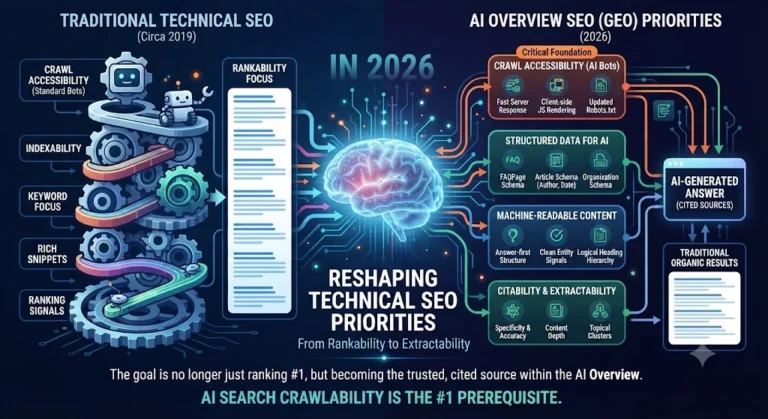
Traditional technical SEO optimized for one reader: a search engine crawler indexing pages to rank them in a list. AI overviews introduce a second reader — a language model that needs to extract, verify, and synthesize an answer in real time, often without a full crawl-and-index cycle to lean on.
That second reader is far less forgiving of ambiguity. A page that ranks fine on page one but buries its actual answer under three paragraphs of preamble might get skipped entirely for citation, even while it still shows up in traditional results. The two systems are judging different things: rankability versus extractability.
Generative engine optimization borrows a lot from technical SEO, but it adds requirements that didn’t matter as much before:
Answer-first content structure. AI systems favor pages where the direct answer appears within the first couple hundred words, not after a scene-setting introduction. If a human has to scroll to find the answer, so does the model — and it’ll often just move to a source that doesn’t make it scroll.
Clean entity signals. Names, places, products, and services need to be stated explicitly and consistently, not implied through pronouns or vague references. “Our team handles this” tells a crawler nothing; “ABC Plumbing handles emergency repairs in Austin” gives the model something concrete to extract and attribute.
Machine-parseable hierarchy. Headings need to reflect actual logical structure — not just visual styling. An H2 that’s really just bold text with a bigger font confuses automated parsing even when it looks fine to a human eye.
None of this is exotic. It’s the same discipline good technical SEO always demanded — just enforced more strictly, because now a model is grading your clarity, not just a ranking algorithm counting keyword matches.
Crawlability for AI search overlaps with traditional crawlability but isn’t identical to it. A few gaps show up repeatedly:
Fixing crawl accessibility isn’t glamorous work, but it’s the prerequisite everything else depends on. A perfectly structured page that never gets crawled contributes nothing.

Schema markup used to be mostly about winning rich snippets — star ratings, FAQ dropdowns, recipe cards. That’s still true, but structured data for AI search does something additional: it gives generative engines a verified, unambiguous data layer to pull from instead of guessing from prose.
A few schema types carry more weight in this context than they used to:
If your schema strategy still starts and ends with product ratings, there’s a real gap opening up between you and competitors treating structured data as an AI-facing data layer, not just a snippet trick.
Zero-click search — where the user gets their answer without visiting any site — isn’t new, but AI overviews have accelerated it. The uncomfortable reality: for a growing share of informational queries, ranking #1 doesn’t guarantee a click anymore. It guarantees a shot at being the cited source inside an answer the user never leaves the results page to escape.
That changes the ROI calculation for some content. A page written purely to capture search traffic needs a different justification now — because “getting seen and cited” and “getting clicked” are increasingly separate outcomes. Brand visibility inside AI answers still has value, even without the click, but it’s a different metric than the one most SEO reporting is built around.
Getting cited inside an AI overview isn’t random. Patterns worth building toward:
If this feels like a lot at once, the realistic order of operations is: fix crawl accessibility first (nothing else matters if the page isn’t reachable), then tighten structured data on your highest-value pages, then rework the top of your most important content so the answer isn’t buried. Chasing every GEO tactic at once, on every page, usually means none of it gets done properly.
For a full breakdown of how schema markup specifically supports this — the field-by-field detail we didn’t have room for here — the Schema Markup guide in this series goes deeper into implementation. And for the broader technical SEO checklist this piece sits inside, see the Technical SEO pillar page
Alongside it. Traditional ranking factors still decide whether a page is competitive at all; AI-readiness decides whether a competitive page also gets extracted and cited.
GEO focuses on making content extractable and citable by AI systems in real time, while traditional SEO focuses on ranking in a list of links. They share a technical foundation but optimize for different endpoints.
You need to check your robots.txt and server logs against current AI crawler user-agents specifically, since some sites unintentionally block them with rules written for older bots.
Making sure your core content isn’t locked behind client-side JavaScript that goes unrendered, and that response times on key pages are fast and consistent.
FAQPage, Article/BlogPosting with clear authorship and update dates, and Organization/LocalBusiness schema tend to carry the most weight for AI-facing extraction.
Not dying, but shifting. Some queries will always drive clicks; others increasingly resolve inside the AI answer itself, which changes what “success” looks like for that content.
Be specific rather than vague, keep your visible content and structured data consistent with each other, and build topical depth through a well-linked content cluster rather than isolated pages.
Depth. A shorter page that answers the question precisely and specifically will out-cite a longer page padded with generic explanation.
Partially — content structure, heading hierarchy, and direct-answer placement are editorial fixes. Schema implementation and crawlability issues usually need developer or CMS-level changes.
A quarterly audit is a reasonable baseline right now, since crawler behavior and AI citation patterns are still shifting faster than they were in the pre-AI-overview era.
If you’re not sure whether your pages are even crawlable by current AI systems — or whether your schema is doing any real work — that’s the place to start before writing another word of content. Reach out for a technical SEO + GEO audit: 9718159724.