Voice Search and Local SEO: What “Near Me” Queries Actually Need
Voice Search and Local SEO: What “Near Me” Queries Actually Need Voice search local SEO is about making your business...
Read More → Ask ChatGPT or Perplexity for the best provider of any service and you’ll notice something odd: there’s no page two and no list of ten blue links. You get one answer that names a few brands. Brand mention optimization for AI search is the work of making sure your brand is one of those names, and that the AI describes you accurately when it says it. In practice, that means restructuring your website content so machines can easily extract it, verify it, and attribute it to you.
This guide walks through what to change on your site, in the order that tends to matter most. It’s part of our wider AIO/GEO Optimization Services work, so if you want the full strategy behind these steps, start there.
AI search tools (Google AI Overviews, ChatGPT search, Perplexity, Copilot) don’t rank pages the way classic search does. They pull passages from sources they can understand and trust, then blend them into a single answer. Three things decide whether your content gets pulled, and they sit at the core of brand mention optimization for AI search:
Miss any one of these and a competitor with cleaner content gets the mention instead of you.
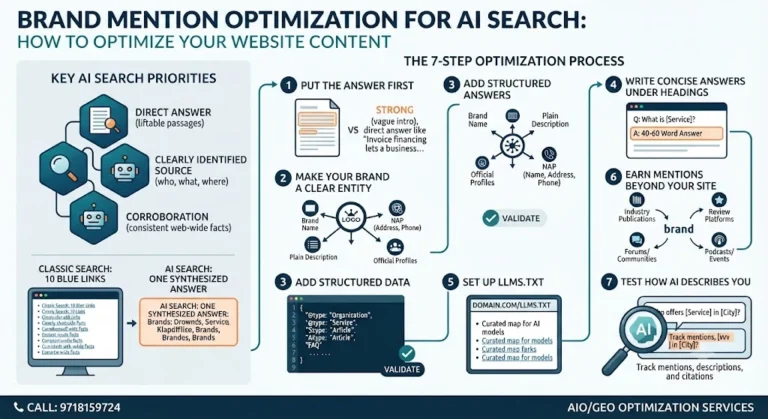
Most business pages open with a warm-up paragraph about “the changing digital landscape.” An AI model skips right past it. Open every important page by answering the question the page exists for, in plain words, before anything else.
Compare these two openings for a page about invoice financing:
The second one can be quoted as it stands. That’s the test for concise answers: could a stranger read just this sentence and understand the point?
Entity optimization is the foundation of brand mention optimization for AI search, and the idea behind it is simple. AI systems need to be sure that “your brand” is one specific, identifiable thing, not a vague string of words. To help them:
A brand that describes itself three different ways across the web gives an AI three reasons to hesitate.
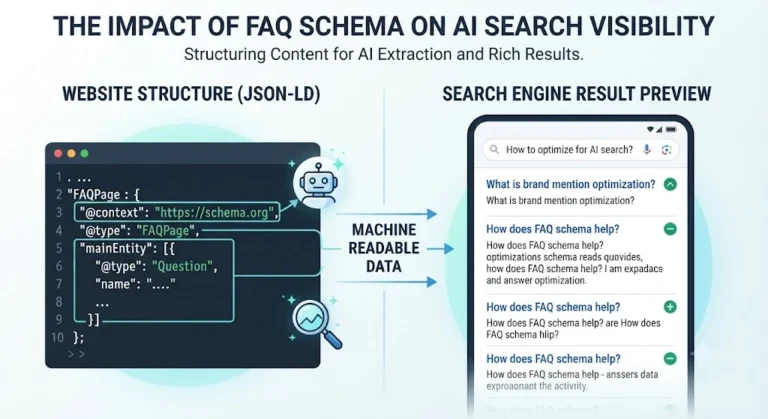
Structured data is code that labels your content for machines: this is an organization, this is a service, this is a question with an answer. The types worth starting with are Organization, Service (or Product), Article, and FAQ schema.
Two honest caveats. First, Google limited FAQ rich results in search to a narrow set of sites back in 2023, so don’t expect the visual accordion in results. FAQ schema still gives machines a clean question-and-answer structure, which is why it’s still worth adding. Second, markup must mirror visible content. If the schema says something the page doesn’t, you’re creating a trust problem, not solving one.
Validate everything with Google’s Rich Results Test or the Schema Markup Validator before publishing.
Turn your headings into the questions people actually ask, then answer each in 40 to 60 words before going deeper. Think of it as a two-layer page: a short extractable answer on top, and the nuance underneath for humans who want it.
A few habits that help:
The llms.txt file is a proposed standard: a plain Markdown file at the root of your site (yourdomain.com/llms.txt) that gives language models a short, curated map of your most important pages. Think of it as a reading list for AI, written by you.
Be realistic here. As of now, the major AI search platforms haven’t confirmed that they officially read llms.txt or treat it as a ranking factor. The cost of adding one is low, though, and it forces you to decide which pages define your business, which is useful for brand mention optimization for AI search whatever any engine does with it. If you’d rather not build it yourself, an llms.txt optimization service can handle the file, the page selection, and the descriptions.
A decent llms.txt has your brand name and one-line description at the top, then grouped links to your key services, guides, and policies, each with a short note on what the page covers.
AI models don’t only read your site. They lean on what other sources say about you, which is why brand mention optimization for AI search can’t stop at on-page fixes. Look at where a buyer in your field would naturally learn about you:
The goal isn’t volume. One accurate mention on a respected industry page does more than fifty scraped directory listings.
You can’t optimize what you don’t measure, and brand mention optimization for AI search is no exception. Once a month, run the same set of 10 to 15 prompts across ChatGPT, Perplexity, and Google’s AI Overviews. Use questions your customers would ask, such as “who offers X in [city]” or “best way to solve Y”. Log three things: whether you’re mentioned, how you’re described, and which sources the AI cites.
The citations are the most useful part. They show you exactly which pages the AI trusts in your space, and those are the pages where you want to appear.
It’s the practice of shaping your website content and off-site presence so AI tools such as ChatGPT, Perplexity, and Google AI Overviews name your brand in their answers, and describe it correctly.
Traditional SEO aims to rank a page in a list of results. AI search content optimization aims to get your content extracted and cited inside a generated answer. The fundamentals overlap (quality, clarity, authority), but AI search puts extra weight on direct answers, clear entities, and consistent facts across the web.
It helps machines understand what your page is about, who published it, and how the pieces relate. It isn’t a guaranteed ticket into AI answers, but accurate structured data removes ambiguity, and ambiguity is what makes AI systems pick someone else.
Yes, for a different reason. Even without the expandable results in Google, FAQ schema gives a clean question-and-answer format that machines can parse easily. Just make sure every marked-up question and answer is visible on the page.
It’s a proposed Markdown file at your site’s root that lists your most important pages for language models. It’s not required, and major platforms haven’t confirmed they use it, but it’s cheap to add and helps you clarify which pages matter most.
Typically it covers choosing which pages belong in the file, writing accurate one-line descriptions, structuring the Markdown correctly, uploading it to the right location, and updating it when your site changes.
Aim for roughly 40 to 60 words for the direct answer under each heading. That’s long enough to be complete and short enough to be quoted. Add depth after it, not instead of it.
It’s making your brand identifiable as one specific, consistent entity: the same name, description, contact details, and official profile links everywhere. This lets AI systems connect mentions of you across different sources.
There’s no fixed timeline, and anyone promising one is guessing. Technical fixes can be picked up within weeks, while off-site mentions and trust build over months. Track your progress with monthly prompt tests instead of waiting for a single big change.
You can handle the basics of brand mention optimization for AI search yourself: clearer answers, consistent brand details, and basic schema. An agency helps most with structured data at scale, llms.txt, off-site mention strategy, and ongoing measurement. Our AIO/GEO Optimization Services cover all of these.
Brand mention optimization for AI search rewards the sites that make themselves easy to understand: a direct answer at the top of the page, a brand that’s described the same way everywhere, structured data that matches the content, and third-party sources that back you up. None of these steps is glamorous, but together they decide whether an AI names you or your competitor.
Start small. Rewrite the opening of your five most important pages, fix any inconsistencies in your brand details, and run your first round of prompt tests this week. Then build outward toward schema, llms.txt, and off-site mentions.
If you’d like a team to audit where your brand stands in AI answers today and build a plan around it, call us on 9718159724. We’ll look at how AI tools currently describe your business and tell you what to fix first.