Voice Search and Local SEO: What “Near Me” Queries Actually Need
Voice Search and Local SEO: What “Near Me” Queries Actually Need Voice search local SEO is about making your business...
Read More → If your product pages aren’t showing up on Google, the fix usually isn’t more content — it’s fixing the handful of things Google actually checks before it trusts a product page enough to rank it: structured data, unique descriptions, real reviews, and images that are actually readable by search engines. Get these right and even a single product page can start pulling in organic traffic without touching your ad budget.
This is exactly the kind of work an ecommerce seo service provider handles day to day, because product pages behave very differently from blog posts or category pages when it comes to SEO.
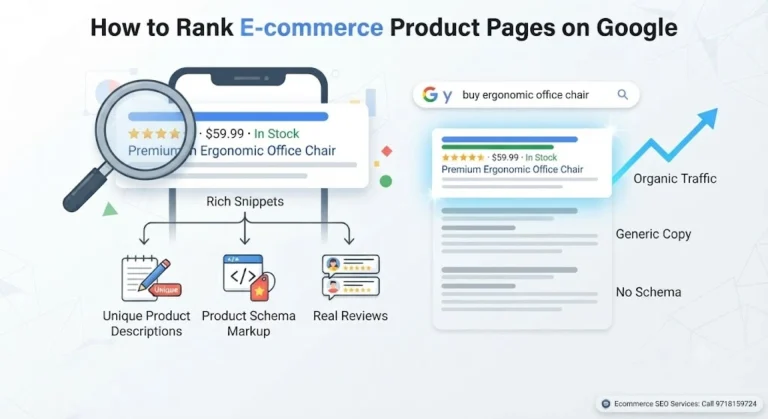
A blog post only has to answer a question. A product page has to answer a question, sell something, and compete against a hundred other listings that are selling the exact same item — often with the exact same manufacturer description pasted word for word. Google can tell when ten pages are running identical copy, and it has no reason to rank the eleventh copy any higher.
That’s the core problem most ecommerce sites run into. The product exists on Amazon, on three other marketplaces, and on your own site, usually with the same three-paragraph description the supplier sent over. Ranking a product page means giving Google — and the shopper — a reason to trust this page over the identical ones.
Copy-pasted manufacturer descriptions are the single biggest reason product pages don’t rank. If your description is identical to fifty other sellers’, there’s nothing for Google to differentiate on.
A description that actually helps rankings usually covers:
Two products in the same category shouldn’t read like templates with the color swapped. If a shopper could paste your description into a different product and it would still make sense, it’s not specific enough yet.
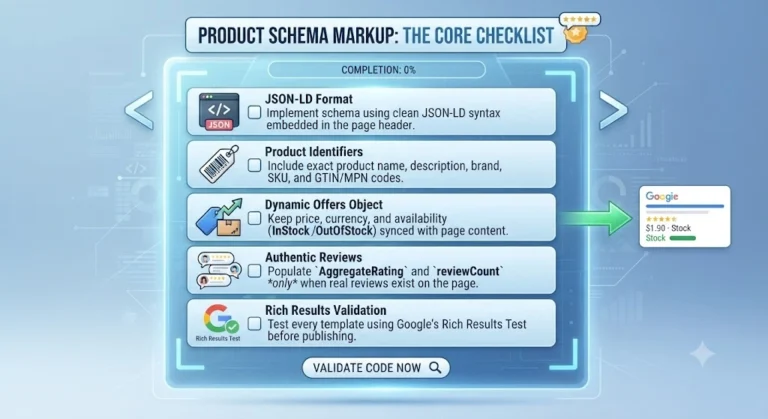
Product schema markup is what turns a plain blue link into a result showing price, stock status, and star ratings directly on the search page. Google can technically read your page without it, but schema removes the guesswork — you’re telling Google exactly what the price is, whether it’s in stock, and what the aggregate rating is, instead of hoping it figures that out from the page layout.
At minimum, a product page’s schema should include:
A mismatch between schema data and what’s visible on the page — say, schema saying “in stock” while the page shows “sold out” — is treated as a red flag, not a technicality. It’s worth auditing this after every price change or restock, not just at launch.
Reviews do two jobs at once: they generate fresh, unique text on the page that no competitor can copy, and they’re a trust signal Google’s systems are specifically built to weigh for shopping-related queries.
A product page with twelve detailed reviews mentioning fit, sizing, delivery time, and specific use cases will usually outperform a page with a “4.8 stars” badge and no visible reviews behind it. If review volume is currently low, the honest move is to focus on getting a handful of detailed, real reviews rather than displaying a rating that isn’t backed by visible content — a bare star icon with nothing to back it up doesn’t add the trust it’s meant to signal.
Product images carry real search traffic through Google Images and visual search, but only if the alt text actually describes what’s in the frame. “IMG_2938.jpg” or generic alt text like “product photo” tells search engines nothing.
Alt text that helps should describe the product specifically — material, color, angle, and context — the way you’d describe the photo to someone who couldn’t see it. This also matters for accessibility, so it’s not purely an SEO checkbox; it’s doing two jobs with one line of text.
Fixing individual product pages helps, but it’s usually part of a larger structure — category pages, internal linking between related products, and a technical foundation that lets Google crawl the catalog efficiently in the first place. This is the kind of end-to-end work covered under ecommerce seo services as a whole, rather than treating each product page as an isolated fix.
There’s no fixed timeline — it depends on domain authority, competition for that specific product, and how fast Google recrawls the page. Some pages show movement within a few weeks; more competitive categories take longer.
Not necessarily from scratch, but it’s worth checking. Many platforms generate partial or outdated schema, especially around price and stock status, so a manual audit is still useful even on Shopify, WooCommerce, or similar platforms.
Yes, but it’s harder. Focus on a genuinely unique, detailed description and strong technical setup first, and add reviews as they come in naturally rather than delaying launch for them.
Google doesn’t necessarily “penalize” it in a manual-action sense, but it has little reason to rank a page that offers nothing beyond what a dozen other pages already say. The practical effect looks the same as a penalty — the page just doesn’t surface.
Yes, ideally. Thumbnails and gallery images should each describe what’s actually shown (angle, color, context) rather than repeating the same alt text across every image on the page.
They work together rather than competing. The description establishes what the product is and who it’s for; reviews build the trust layer on top of that. Weak on either side limits the page.
Yes. A clean, readable URL that includes the product name is easier for both users and search engines to understand than an auto-generated string of numbers and parameters.
Anytime the price, stock status, or rating changes. Stale schema that contradicts the visible page content is a common and avoidable issue.
Yes. Category pages and internal linking help Google understand where a product sits in the site’s structure, which affects both crawlability and how much authority flows to that product page.
It depends on catalog size and available time. A handful of products can often be fixed manually; a catalog running into hundreds or thousands of SKUs usually benefits from a dedicated ecommerce SEO service provider who can audit and fix these issues at scale rather than product by product.
Ranking a product page isn’t about writing more content for the sake of it — it’s about fixing the specific things Google checks before it trusts a page enough to show it: a description that isn’t copy-pasted, schema markup that matches reality, reviews that are actually visible, and image alt text that says something real. Most product pages that aren’t ranking are missing two or three of these, not all of them, which is usually good news — the fixes are specific and doable.
If you’d rather have this handled end-to-end across your full catalog instead of page by page, that’s exactly what our ecommerce SEO services are built for. Call us at 9718159724 to talk through your catalog and where the quickest wins are.