Voice Search and Local SEO: What “Near Me” Queries Actually Need
Voice Search and Local SEO: What “Near Me” Queries Actually Need Voice search local SEO is about making your business...
Read More → Most ecommerce sites lose more ranking potential on category pages than anywhere else on the site. Product pages get all the attention, but it’s the category page — /mens-running-shoes/, /kitchen-appliances/, /winter-jackets/ — that actually competes for the high-volume, high-intent keywords people search before they’ve picked a specific product. Get the category page wrong, and you’re stuck fighting for scraps with long-tail product titles instead.
If you’re running an ecommerce store and searching for ecommerce SEO services in Delhi NCR, category page optimization is usually the single biggest lever nobody’s pulled yet. Here’s what actually moves the needle.
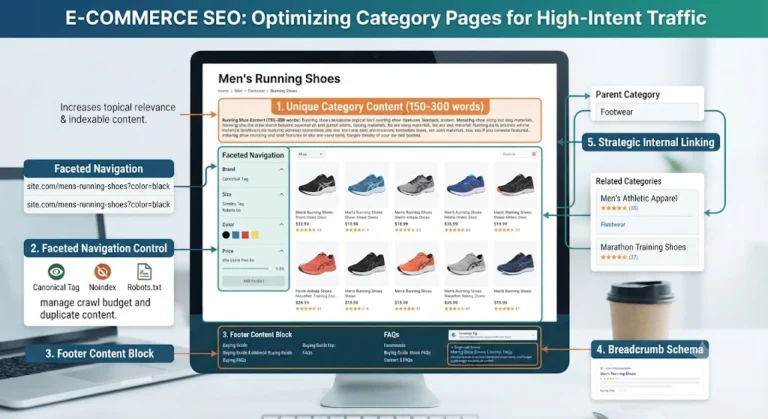
A category page sits right at the intersection of what a shopper types into Google and what your store actually sells. Someone searching “buy running shoes online” isn’t looking for one product — they’re looking for the whole shelf. That’s a category page’s job, and it’s exactly the kind of page that can rank for commercial, high-intent terms your individual product pages never will.
The problem is most category pages on Indian ecommerce sites are thin — a grid of products, a filter sidebar, and nothing else. No context, no content, nothing for Google to actually understand what the page is about beyond the product titles. That’s a wasted opportunity, and it’s fixable.
A short block of unique text at the top — 150 to 300 words explaining what the category covers, who it’s for, and what to look for — gives Google something to actually index beyond a list of SKUs. Skip generic filler like “We offer the best quality products at the best prices.” Say something specific: sizing notes, material differences, seasonal relevance, whatever a real shopper on that page would want to know before they scroll.
A second content block near the footer works well for depth — buying guides, common questions, or comparisons between subcategories — without pushing the products themselves below the fold.
Faceted navigation SEO is where most Indian ecommerce sites quietly bleed rankings. Filters for size, color, brand, and price are great for shoppers and terrible for search engines when they’re left unmanaged — because every filter combination generates a new URL. A store with 50 products and five filter types can generate thousands of near-duplicate URLs without anyone noticing.
Left unchecked, this creates three problems at once:
The fix isn’t to remove filters — it’s to control which filter URLs get indexed. Canonical tags pointing filter variations back to the main category page, noindex on low-value combinations, and robots.txt rules for parameters that add no search value (like sort order) all help. Which filters are worth their own indexable page — usually high-search-volume ones like “running shoes for men size 9” — should be a deliberate decision, not an accident of how the filter system was built.
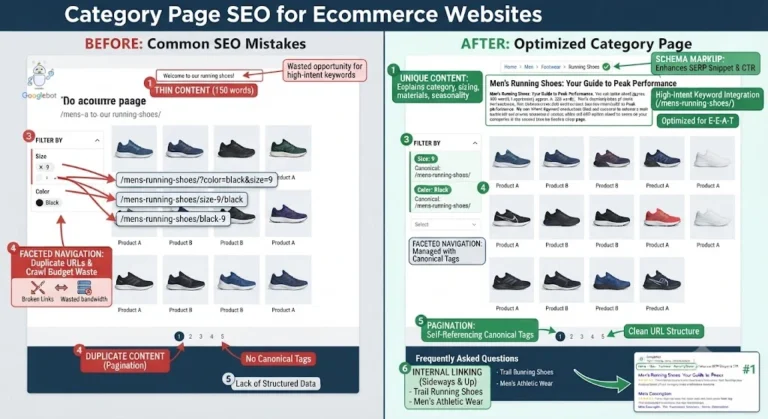
Beyond faceted navigation, duplicate content shows up in category pages through pagination (page 2, page 3 of a category), sort parameters, and sites that push the same products into multiple categories with identical descriptions. Self-referencing canonical tags on every category and paginated page, combined with clean pagination handling, keep Google from splitting ranking signals across near-identical URLs. If a product genuinely belongs in two categories, the category page content itself should still be unique — the product listing can repeat, the surrounding text shouldn’t.
Breadcrumb schema does two things well: it gives users a visible trail back through the site hierarchy (Home > Men > Footwear > Running Shoes), and it gives Google structured data that reinforces your site’s topical structure. Implemented correctly, breadcrumbs often show up directly in the search snippet, which improves click-through rate even before ranking position changes. This is a small technical addition with an outsized effect on how clean your site structure looks to a crawler.
Category pages should link both up and sideways — up to the parent category or the main ecommerce SEO services pillar page, and sideways to closely related categories a shopper might also want. This isn’t just for users; it tells Google which pages are the authoritative hub for a topic. A category page that’s only ever linked to from the homepage nav and nowhere else in the site’s content is telling Google it’s not that important — even if it’s actually one of your highest-converting pages. Pairing this with clean on-page fundamentals (title tags, header structure, image alt text) is exactly where on-page SEO work overlaps with category-level fixes, and the two should be handled together rather than as separate projects.
If you’re not sure where to start, audit your top 10 category pages by traffic or revenue first — not every category on the site. Check for: unique content above the fold, canonical tags on filter URLs, whether pagination is creating duplicate indexing issues, and whether breadcrumb schema is even implemented. Most stores find two or three of these broken at once, and fixing them on the highest-value categories first shows measurable movement before you touch the long tail.
It’s the process of optimizing the listing pages that group multiple products together — like “Men’s Shoes” or “Kitchen Appliances” — so they can rank for broader, higher-volume search terms, rather than relying only on individual product pages to attract traffic.
Usually it comes down to thin content, duplicate URLs created by filters and pagination, or a lack of internal links pointing to the category page. Google can’t rank a page well if it can’t tell what makes that page unique from ten similar-looking URLs on the same site.
Start with your highest-traffic and highest-revenue categories. Writing genuinely useful, specific content for 10 well-chosen categories beats generic filler spread across 200 of them.
Every filter combination — color, size, price range, brand — typically generates its own URL. If none of those are canonicalized or noindexed, search engines can end up crawling and indexing hundreds of near-identical pages instead of the one you actually want ranking.
Only the ones with real search demand. A filter combination like “black running shoes size 9” might be worth indexing if people actually search for it. A sort-by-price URL almost never is. This should be decided case by case, not applied as a blanket rule.
Self-referencing canonical tags on each paginated page, clear internal linking between pages, and making sure paginated URLs aren’t competing with page 1 for the same keyword.
It’s a smaller technical fix but a reliable one — it reinforces site structure for crawlers and often improves how the page displays in search results, which can lift click-through rate independent of ranking changes.
Not alone, but it’s one of the fastest wins available. A category page with no internal links pointing to it beyond the main navigation is signaling low importance to Google, regardless of how good the on-page content is.
It varies by site size, competition, and how broken the current setup is, but structural fixes like canonicalization and internal linking typically show movement within a few months, while content and authority-building compound over a longer period.
A developer can implement the technical fixes, but deciding which filter combinations to index, what content each category needs, and how the internal linking should flow requires SEO strategy — that’s usually where an outside audit or ongoing SEO support helps most.
If your category pages are sitting on page two while your competitors’ near-identical listings rank above you, it’s rarely a content problem alone — it’s usually filters, duplication, and internal linking working against you at the same time. A proper audit will show you exactly which of your categories are losing the most traffic to these issues, and where to fix them first.
Call 9718159724 to get your ecommerce store’s category pages audited and put together a fix plan that starts with your highest-value pages.