Free vs Paid SEO Audit: Which One Should You Choose
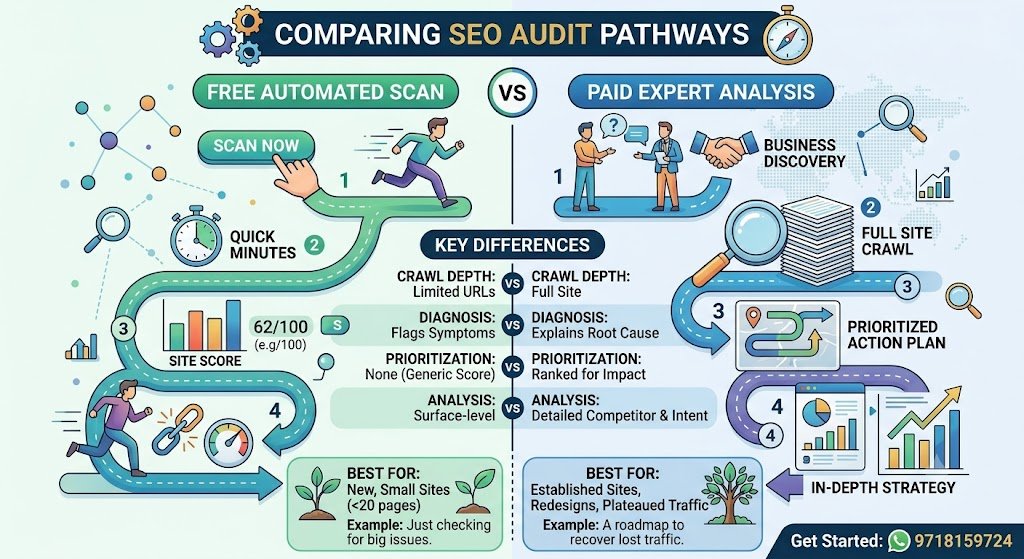
A free SEO audit tool will scan your site in under two minutes and hand you a score out of 100. A paid SEO audit service will take days, ask you questions about your business, and hand you a plan. That difference — automated scan versus expert diagnosis — is really the whole decision. If you’re a new site checking for obvious red flags, free tools are enough. If you’re losing rankings, stuck in a traffic plateau, or planning a redesign, you need a real SEO audit service that can explain why, not just what.
Let’s break down exactly where each option holds up, where it falls apart, and how to pick without wasting a month finding out the hard way.
What a Free SEO Audit Actually Checks
Free tools — think Ubersuggest, Screaming Frog’s free tier, SEMrush’s limited crawl, or Google’s own PageSpeed Insights — are built to scan patterns, not context. They’re good at:
- Missing title tags or meta descriptions
- Broken links and 404s
- Basic page speed scores
- Missing alt text on images
- Duplicate content flags
- A surface-level backlink count
This is genuinely useful. If your site has never had any technical attention, a free scan will catch the low-hanging fruit fast, and it costs nothing to run. For a five-page brochure site or a blog that’s just getting started, this might be all you need for the first year.
Where Free Tools Run Out of Road
Here’s the limitations of free tools that don’t show up until you’ve already acted on bad advice: they flag symptoms without diagnosing causes. A free audit report will tell you “page speed is slow” — it won’t tell you whether that’s because of unoptimized images, render-blocking JavaScript, a bloated theme, or server response time, and it definitely won’t tell you which of those is actually costing you rankings versus which is just noise.
Free tools also can’t do a few things that matter a lot once your site has real traffic:
- They don’t crawl deep. Most free plans cap you at 100–500 URLs. A mid-sized e-commerce site can have 10,000+ URLs, and the problems are usually hiding in the pages you can’t see in a free scan.
- They don’t understand search intent. A tool can tell you a page ranks for a keyword; it can’t tell you the keyword is the wrong one for what that page actually offers.
- They generate generic scores, not prioritized fixes. A 62/100 score doesn’t tell you whether to fix your sitemap first or your internal linking first — and fixing things in the wrong order can waste weeks.
- They miss log-file and crawl-budget issues. Googlebot’s actual crawl behavior on your site (what it’s skipping, what it’s crawling too often) is invisible to consumer-facing tools.
If you’ve run a free scan, fixed everything it flagged, and traffic still isn’t moving — that’s usually the exact signal that you’ve hit the ceiling of what automation alone can find.
What a Paid SEO Audit Service Adds
A proper SEO audit service starts where the free tools stop. Instead of a generic checklist, you get a full crawl of your actual site structure, a review of your search console and analytics data, competitor gap analysis, and — the part free tools can’t replicate — a human who’s actually looked at your industry and your specific pages and connected the dots between the technical findings and your business goals.
The audit report you get back from a paid service typically includes:
- A full technical crawl (not capped at a few hundred URLs)
- Search intent mapping against your current content
- A prioritized action list — ranked by effort vs. impact, not just severity
- Competitor comparison showing exactly where they’re beating you and why
- Crawl budget and indexation analysis
- A content and internal linking plan, not just a list of broken links
This is where our Technical SEO Audit Services come in — the difference isn’t more line items, it’s that every finding is tied back to what’s actually stopping your pages from ranking, with a clear next step attached.
Free SEO Audit vs Paid SEO Audit Tools: Side by Side
Free SEO Audit | Paid SEO Audit Service | |
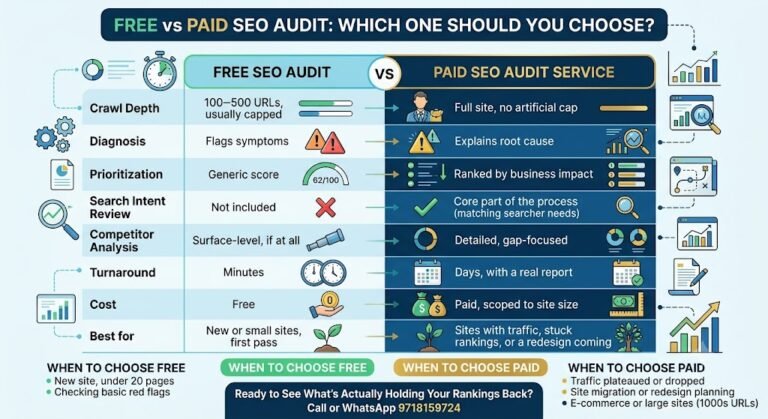
Crawl depth | 100–500 URLs, usually capped | Full site, no artificial cap |
Diagnosis | Flags symptoms | Explains root cause |
Prioritization | Generic score | Ranked by business impact |
Search intent review | Not included | Core part of the process |
Competitor analysis | Surface-level, if at all | Detailed, gap-focused |
Turnaround | Minutes | Days, with a real report |
Cost | Free | Paid, scoped to site size |
Best for | New or small sites, first pass | Sites with traffic, stuck rankings, or a redesign coming |
So Which One Should You Actually Choose?
Run a free tool first if you’ve genuinely never had any SEO attention on your site — it’s a fast way to catch obvious mistakes before you spend a rupee. But treat it as step one, not the finish line.
Choose a paid SEO audit service the moment any of these are true:
- Your traffic has plateaued or dropped despite regular content publishing
- You’re planning a site migration, redesign, or CMS change
- You’re spending on ads because organic isn’t pulling its weight
- A free scan came back “clean” but rankings still haven’t improved
- Your site has more than a few hundred pages
The honest answer for most established businesses is that free tools are a starting point, not a strategy. They’re built to give you a snapshot, not a plan — and a snapshot doesn’t fix rankings.
Frequently Asked Questions
Is a free SEO audit good enough for a small business website?
For a brand-new site with under 20 pages, yes — a free audit will catch the basics like missing meta tags or broken links. Once the site has real traffic or age, a paid audit report gives you far more usable direction.
. How much does a professional SEO audit service usually cost?
Pricing depends on site size and depth — a small site audit is far cheaper than a full e-commerce or enterprise audit. The right way to know is to get a scope based on your actual URL count and goals rather than assuming a flat number.
. Can I just run multiple free tools instead of paying for one audit?
You can, but you’ll get overlapping surface-level findings from each tool and still miss root-cause analysis, search intent mismatches, and prioritization — the parts that actually move rankings.
What's the biggest limitation of free SEO audit tools?
Crawl depth and diagnosis. Free tools cap how many pages they scan and tell you what’s wrong without explaining why it’s wrong or what to fix first.
How long does a paid SEO audit take to complete?
It varies with site size, but expect a proper audit to take several days rather than minutes — real crawling, data review, and report-writing take time that automated tools skip.
Will a paid audit guarantee higher rankings?
No audit — free or paid — can guarantee rankings, since that depends on execution after the audit too. What a paid audit does guarantee is a clear, prioritized understanding of what’s actually blocking you.
Do free SEO audit tools work for e-commerce sites?
They’re weaker here specifically because e-commerce sites have thousands of URLs, faceted navigation, and duplicate content risks that free tools’ crawl caps simply can’t cover.
What should a good SEO audit report actually include?
Beyond a list of issues, it should include prioritization by impact, root-cause explanation, competitor comparison, and a content/technical action plan — not just a score.
How often should a site get a full paid SEO audit?
Most sites benefit from a full audit annually, with a lighter check-in after any major change like a redesign, migration, or algorithm update that visibly affects traffic.
Should I get an SEO audit before or after a website redesign?
Before. An audit before a redesign protects your existing rankings by flagging what’s currently working, so a new design or CMS migration doesn’t accidentally undo it.
Ready to See What's Actually Holding Your Rankings Back?
A free scan can tell you something’s wrong. A real SEO audit service tells you exactly what, why, and what to fix first. If your traffic has stalled or you’re planning any changes to your site, get in touch for a proper audit — call or WhatsApp 9718159724 to get started.